
What Is Authentic Engagement and Why It Matters for Growth
What Is Authentic Engagement. Discover what authentic engagement really means for creators and brands. Learn the signals, common misconceptions, and actionable
Have you ever received hundreds of likes on a post, only to notice that almost nobody understood, remembered, or responded to the idea behind it? That gap exposes the weakness in conventional growth advice. Visible activity isn't the same as authentic engagement.
Authentic engagement is the quality of connection created when people respond because a message is useful, relevant, credible, or personally meaningful. It can include a thoughtful reply, a follow that reflects genuine interest, a question that moves a conversation forward, or a quiet change in how someone sees a topic. The important signal isn't just whether an interaction happened. It's whether the interaction fits the person, the message, and the community.
For creators, founders, and social media managers, this distinction changes how you plan content. You still need reach and measurable activity, but those numbers should help you investigate relationships rather than replace them. The practical question becomes: what evidence shows that an audience trusts the account enough to pay attention and participate?
Rethinking What It Means to Truly Connect
If a post attracts constant activity but leaves no useful conversation behind, has it really engaged anyone? High posting volume, rapid replies, and growing follower counts can create the appearance of momentum while masking weak relevance or shallow attention.
That doesn't mean surface metrics are worthless. Likes, replies, follows, and impressions can reveal distribution and interest. They become misleading when teams treat them as proof of trust. A reply that says “Great post” may count beside a detailed response that adds an example, challenges an assumption, or helps another reader. The platform records both actions, but the community experiences them differently.

Activity is evidence, not the conclusion
A useful definition of what is authentic engagement starts with intent and context. Someone engages authentically when their action reflects real attention and makes sense within the conversation. A founder answering a specific product question demonstrates a different kind of connection from an account posting generic replies across unrelated threads.
The difference becomes clearer when you examine three questions:
- Does the interaction contain substance? It might verify a fact, offer a useful observation, or ask a precise question.
- Does it sound like the account? The language, opinions, and level of expertise should fit the creator's established identity.
- Does it respect the audience's context? Timing, cultural references, and the emotional tone of the discussion all matter.
This approach turns authenticity from a vague feeling into an observable pattern. You can review replies, compare them with earlier writing, and assess whether the interaction contributes something that another person would reasonably value.
Practical rule: Measure the conversation your activity creates, not just the activity your dashboard counts.
The shift also protects creators from a common trap. Chasing every visible interaction can encourage rushed replies, repetitive content, and tactics that inflate numbers while weakening credibility. A smaller set of relevant conversations may provide a stronger foundation for future trust than a larger set of disconnected actions.
The Three Dimensions of Genuine Engagement
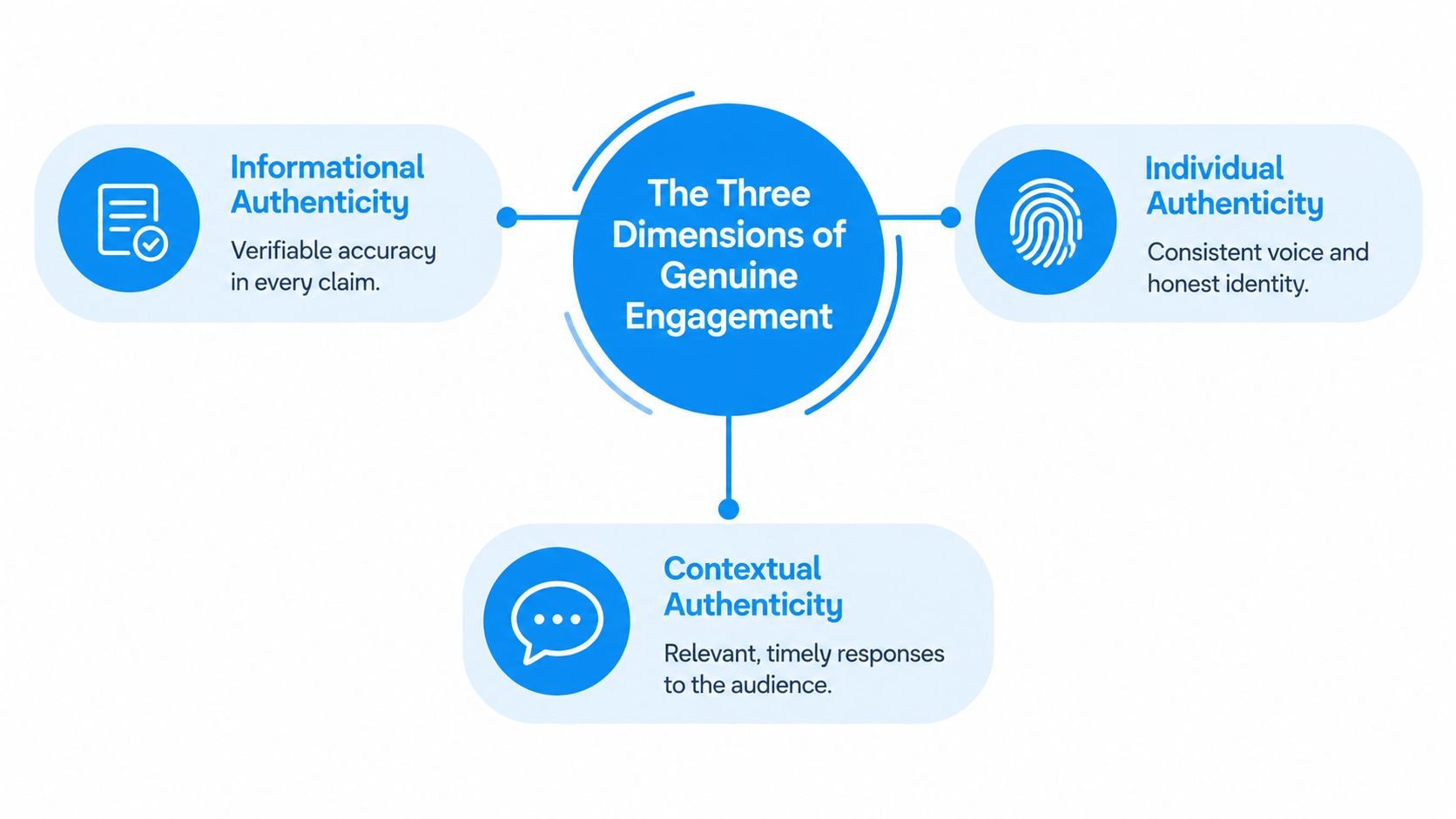
Authentic engagement works across three dimensions: informational authenticity, individual authenticity, and cultural authenticity. The framework comes from research that treats authenticity as a multi-dimensional signal, not a single score. For users of X, it offers a practical way to inspect a post before publishing it.
Informational authenticity
This dimension asks whether your claims are accurate and independently checkable. If you share a product detail, market observation, or news item, readers should be able to understand where the information comes from and assess it for themselves. Precision matters more than sounding certain.
For example, a reply that corrects a misleading claim with a clear explanation can build credibility. A confident reply that repeats an unverified detail may attract attention briefly but weaken trust when readers discover the error.
Individual authenticity
Individual authenticity concerns whether the content feels true to the creator. Consistency doesn't mean repeating the same opinion or using identical wording. It means your tone, values, expertise, and boundaries remain recognizable across conversations.
A technical founder can write plainly, admit uncertainty, and explain trade-offs. If that same account suddenly uses exaggerated promises or generic motivational language, readers may sense a mismatch even when the post is grammatically polished.
Cultural authenticity
Cultural authenticity asks whether a message fits the group, community, or topic it enters. A factually correct reply can still feel intrusive, insensitive, or tone-deaf if it ignores the context of the people involved.
| Dimension | Reader's likely question | Useful check |
|---|---|---|
| Informational | Is this accurate? | Can I verify the claim? |
| Individual | Is this really you? | Does the voice match the account? |
| Cultural | Does this fit here? | Does it respect the community's context? |
These dimensions overlap, but none can substitute for another. A reply may be accurate yet impersonal, personal yet poorly researched, or well written yet inappropriate for the conversation. Strong engagement aligns all three.
Spotting Authentic Signals Versus Inauthentic Activity
A genuine interaction leaves a behavioral trail. It usually fits the account's identity, activity level, and relationship history. Inauthentic activity often looks disconnected when you examine those signals together.
Research on purchased Instagram engagements identified four practical tests for judging whether activity appears genuine: follower growth, service stability, account activity, and profile imagery. These tests don't prove a person's motives, but they show how platforms and users infer authenticity from coordinated behavior rather than from one isolated like or follow. The analysis is available in this research on engagement markets and platform authenticity.
Four traces worth reviewing
- Follower growth: Natural growth generally reflects an account's ongoing content and relationships. Sudden, unexplained bursts deserve investigation, especially when conversation quality doesn't change with them.
- Service stability: Repeated activity should behave consistently. Large fluctuations, disappearing interactions, or unreliable delivery can make engagement look manufactured.
- Account activity: Active profiles with visible participation provide more context than dormant accounts that appear only to like or follow.
- Profile imagery: A realistic, coherent profile supports identity signals. Mismatched or empty imagery can make an interaction feel less credible.
The contrast is practical. An authentic reply arrives from an account with a recognizable voice, relevant history, and a clear connection to the topic. A suspicious reply may appear in volume, use nearly identical language, and come from profiles that show little meaningful activity.
Teams should also examine emotional response, not just behavior. Tools and methods for sentiment analysis in AI visibility can help identify whether audience reactions are supportive, confused, skeptical, or negative. Sentiment doesn't replace human review, but it can surface patterns that raw counts hide.
Automation creates another point of risk. An auto-follow Twitter bot may increase activity, but any workflow that follows people without relevance or conversation can weaken the very trust a growth strategy needs. The standard should be simple: use tools to find and organize meaningful opportunities, not to imitate human interest.
Why Authenticity Does Not Always Equal Higher Engagement
Authenticity sounds like an obvious growth advantage, but evidence doesn't support treating it as a guaranteed engagement multiplier. A 2026 systematic literature review notes that recent meta-analytic evidence found no overall engagement benefit from perceived authenticity alone. The review appears in the International Journal of Consumer Studies and is available in the systematic review of influencer authenticity.
That finding doesn't make authenticity irrelevant. It makes the strategy more precise. Audiences interpret sincerity through platform norms, content format, creator identity, sponsorship context, and the expectations they bring to a conversation. Authenticity can help when it narrows the gap between who an influencer appears to be and what followers expect, but the same signal may have limited effect when the content lacks usefulness or arrives in the wrong context.
Reach and trust solve different problems
Reach answers a distribution question: did the message reach people? Authentic engagement addresses a relationship question: did the message feel credible and relevant enough to earn meaningful attention?
A creator can be transparent and consistent while discussing a topic the audience doesn't care about. Another creator can publish a highly relevant post in a voice that feels manufactured. In both cases, authenticity alone can't create demand. It has to work with clarity, timing, subject relevance, and a format that invites participation.
Sponsorship makes the tension especially visible. A 2024 study in Psychology & Marketing found that TikTok creators who endorse brands through sponsorship are perceived as less authentic, and that this perceived lack of authenticity reduces consumer engagement with brands. The findings are discussed in the study on sponsored TikTok creator endorsements.
The lesson isn't to avoid partnerships or perform an unfiltered version of yourself. It's to disclose relationships clearly, choose collaborations that fit your identity, and explain why the partnership makes sense for your audience. Treat authenticity as a foundation for interpretation, not a promise of automatic performance.
Actionable Strategies to Cultivate Genuine Interactions
Creators don't build authentic engagement by waiting for the right feeling. They create repeatable conditions for useful, recognizable conversations, then review what those conversations reveal.
Start with a voice audit
Collect a representative set of your recent posts and replies. Look for recurring sentence length, vocabulary, opinions, humor, levels of certainty, and subjects you explain well. Write a short style guide that captures what sounds natural for you and what feels forced.
Then use that guide before publishing. A founder might prefer direct explanations and candid trade-offs. A community manager might use a warmer, more facilitative tone. The point isn't to remove personality. It's to prevent every reply from sounding like it came from a different account.
Choose conversations before you choose volume
Scan your timeline for posts where your experience can add something specific. Prioritize questions, emerging discussions, customer language, and thoughtful disagreements over threads that merely have high visibility.
A useful reply often does one of three things:
- Clarifies: It explains a distinction or corrects a misunderstanding.
- Extends: It adds an example, implication, or question that keeps the discussion moving.
- Connects: It links two relevant ideas without hijacking the original conversation.
If you need a broader workflow for turning selective participation into a consistent practice, use this guide on how to get more engagement on Twitter as a planning reference.
Keep a natural cadence
Scheduling can support consistency, but it shouldn't make the account behave like a machine. Leave room for live responses, pauses, and changes in topic. Review scheduled posts before they go out, especially when current events or community sentiment may have shifted.
Finally, measure quality alongside reach. Track which posts lead to substantive replies, repeated conversations, profile visits, and useful questions. An analytics dashboard guide can help you understand how to organize those signals without reducing the community to a single score.

Review before you scale: If a workflow produces more interactions but less relevance, slow it down and inspect the process.
How XBurst Supports Authentic Engagement Workflows
Technology can either create distance from an audience or give a person more time to participate thoughtfully. The difference comes from where automation enters the workflow and whether a human remains responsible for the final interaction.
XBurst is an AI-powered growth platform and Chrome extension for X that analyzes a user's writing style to generate on-brand reply and post drafts. Users can review and edit those drafts before publishing, which supports a human-in-the-loop process rather than pretending that every interaction emerged spontaneously.
From discovery to response
The platform scans timelines to surface high-opportunity conversations and uses opportunity scoring to help users decide which posts deserve attention. Niche trend analysis can reveal topics before they peak, while monitoring top creators helps users find relevant threads early. These features address a practical problem: creators often miss valuable conversations because discovery consumes the time they need for participation.
The workflow still depends on judgment. A suggested reply isn't automatically authentic because software produced it. The user must check its factual accuracy, fit with their voice, and appropriateness for the community. The three-dimensional framework remains the quality filter.
Measurement without losing the human signal
XBurst provides smart scheduling through its dashboard or Telegram, engagement analytics for impressions, likes, replies, and rates, and follower and unfollower management with bulk actions. Multi-account support can help social media managers coordinate several presences, while relationship tracking provides context around conversation momentum and follower relationships.
Those capabilities are most useful when they reduce administrative friction without replacing discernment. A chatbot for X, such as the workflows discussed in this guide to chatbot use on Twitter, should assist with research, drafting, and organization. It shouldn't publish generic replies indiscriminately or manufacture interest.
The strongest operating model is therefore simple: software finds the opportunity, the creator supplies the judgment, and analytics reveal whether the interaction earned trust.
Looking Ahead - The Future of Trust-Based Social Growth
Social growth is moving toward a stricter interpretation of credibility. Audiences can compare a creator's public voice with sponsored content, previous opinions, profile behavior, and the way an account responds when challenged. Platforms also assess activity through patterns involving identity, timing, network behavior, and account consistency.
Consider a creator who builds a reputation by explaining difficult ideas clearly. A relevant brand partnership can fit that identity when the creator discloses the relationship and preserves the same standards of explanation. A mismatched promotion, vague endorsement, or sudden change in tone creates friction because the audience has to reconcile two conflicting versions of the account.
The same principle applies to formats that appear casual. Memes, cultural references, and fast-moving jokes can create strong community signals, but only when the creator understands the group using them. This resource on memes as a Gen Z growth channel offers context for thinking about cultural fit without treating a format as a shortcut to trust.
What sustainable measurement will look like
Future-facing teams will still monitor impressions and replies, but they'll interpret those metrics with richer questions:
- Did the interaction come from a relevant person or community?
- Did the response add information, personality, or context?
- Did the conversation continue beyond the initial reaction?
- Does the account's behavior remain consistent over time?
- Did sponsorship or automation change how audiences interpreted the message?
The answer to what is authentic engagement won't be a universal score. It will be a documented pattern of accurate information, recognizable identity, appropriate cultural context, and behavior that looks coherent to both people and platforms. Creators who build that pattern won't need every post to perform. They'll have a more durable asset, an audience that knows why it should listen.
XBurst helps creators, founders, and brands find high-signal conversations, draft replies in their established style, schedule posts, and review engagement data without removing human approval. Visit XBurst to explore a workflow that makes authentic interaction easier to practice consistently on X.