
Twitter Followers Management That Actually Works in 2026
Master twitter followers management with practical workflows for auditing, organizing, and retaining a real audience on X. Step-by-step tactics and tool tips
You check your X account after a bot purge and see the number moving in the wrong direction. The drop feels alarming, especially when the account looked healthy the day before. Then you inspect the replies, profile visits, and post reactions, and a less comfortable picture appears: a large part of the audience never meaningfully participated.
That's why Twitter followers management should start with retention and audience quality, not an acquisition race. Hootsuite identifies total followers, new followers, unfollows, and net follower growth as the core inputs for audience health tracking in its social media data collection guide. A follower count is only the headline. The operating picture sits underneath it.
Why Twitter Followers Management Is Really a Quality Game
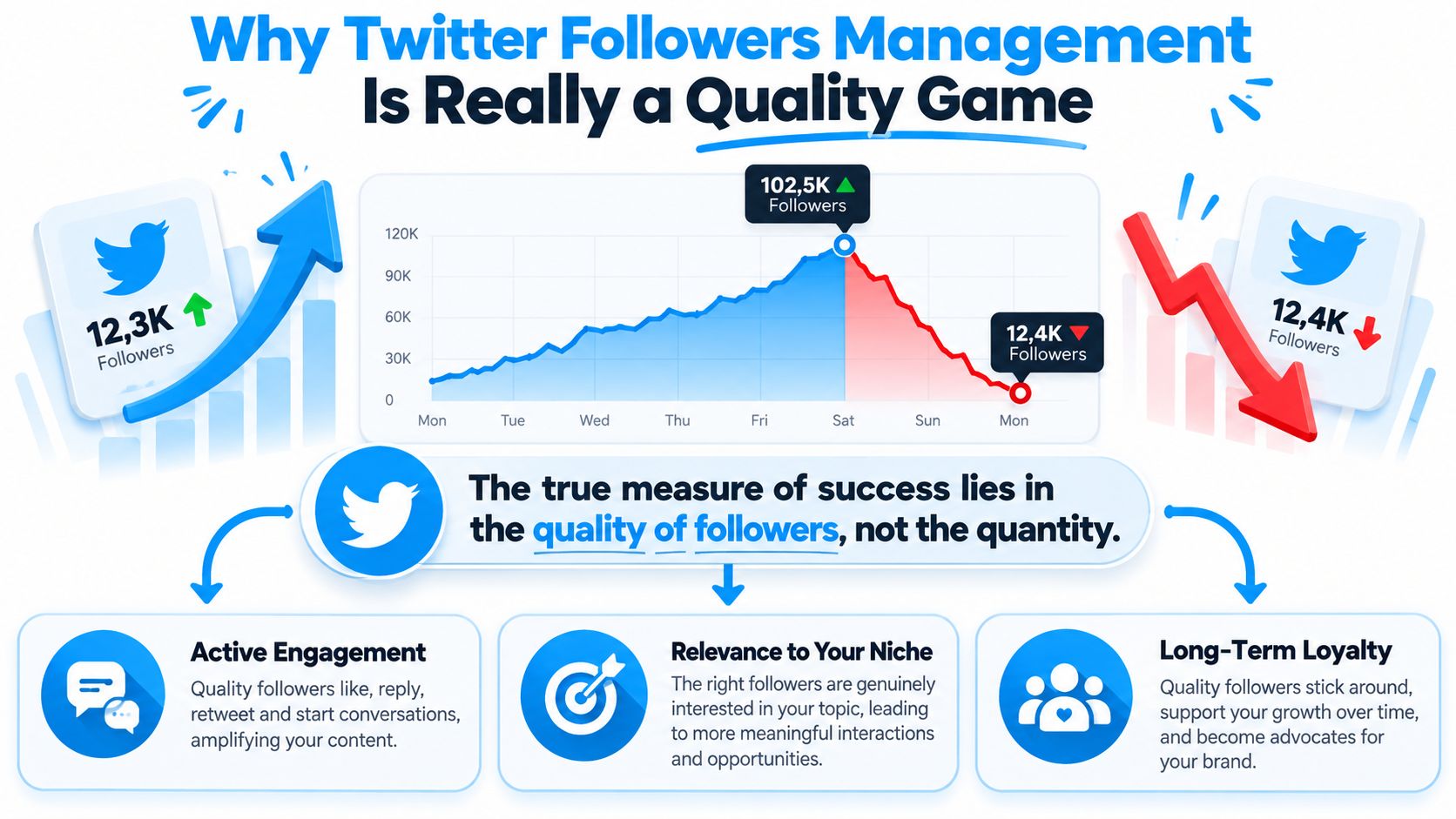
After a bot purge, an account can lose followers overnight and look weaker on paper. A sudden spike can create the opposite impression. Neither change, by itself, proves that your content improved or declined.
The useful question is: who remains, and what do they do? A genuine follower reads your posts, replies to a useful question, shares a strong idea, or visits your profile for a relevant reason. A hollow audience raises the total while adding little to discussion, distribution, or trust.
What a large count can hide
Follower growth on X usually happens incrementally. Hootsuite reports a weekly follower growth rate of 0.11% in one 2025 X statistics collection and lists 0.15% for X in its 2026 social media benchmarks, figures presented together in its X statistics report. At the 0.11% pace, an account with 100,000 followers would add about 110 followers in a week before unfollows or churn.
That context changes how sudden movement should be read. A sharp increase may come from a viral conversation, coordinated activity, or low-quality accounts rather than durable audience demand. A sharp decrease may reflect platform cleanup rather than a content failure.
Poor follower quality creates practical costs:
- Skewed analytics: Low-intent accounts make impressions and follower totals look healthier than meaningful response signals.
- Wasted replies: Time goes toward accounts unlikely to become readers, customers, collaborators, or credible amplifiers.
- Noisy timelines: Irrelevant accounts make useful conversations harder to find.
- Reputational drag: Spam-heavy associations can weaken how people perceive the account.
- Bad decisions: Topics that attract volume may be repeated while losing the audience you want to keep.
Operator rule: A smaller audience that responds to the right subjects is more valuable than a larger audience that only changes the denominator.
Treat the follower list as an operating asset. Some accounts deserve direct attention, some need organizing, some should be muted, and obvious spam may need to be blocked. The work is about preserving a list that supports reach, trust, and useful interaction, and the count is only a byproduct of that.
Running a Follower Audit That Reveals What Your Count Hides
A follower audit works best as a classification exercise, not a purge. You're trying to turn an undifferentiated list into groups with different next actions.
Start with a usable snapshot
Export available follower data or use a follower analytics tool that can capture changes over time. One independent follower-management product describes CSV downloads for up to 50,000 followers per day and an acquisition summary showing followers gained or lost at a glance. That kind of snapshot lets you compare movement instead of relying on memory. If you need a practical way to monitor your audience easily, choose a tool that records both gains and losses rather than displaying only the current total.
Create a spreadsheet with one row per account and columns for:
- Identity: Username, display name, profile URL, and account description.
- Fit: Relevant keywords, location or market, industry, and relationship to your niche.
- Activity: Recent posting pattern, visible replies, and whether the account appears maintained.
- Profile signals: Avatar, bio completeness, external links, and follower-to-following relationship.
- Relationship: Whether the account has engaged with your posts or appears in a useful conversation.
- Action: Keep visible, add to a list, mute, review later, or block.
For a deeper framework on interpreting follower changes, see Twitter follower analysis. Use it to connect list changes with the content and conversations that preceded them.
Segment before deciding
Use practical buckets rather than a single “good” or “bad” label:
- Active audience members engage with relevant posts or consistently show signs of real use.
- Dormant accounts have plausible profiles but little recent activity.
- Industry peers may not engage often but can matter for context, learning, or collaboration.
- Potential partners include customers, journalists, creators, founders, and specialists aligned with your work.
- Suspicious accounts show several warning signs, such as generic bios, copied content, or concentrated promotional behavior.
Cross-reference these groups with your recent post engagement. An account that follows but never appears in your replies, likes, reposts, or meaningful profile visits isn't automatically worthless. Some followers read in silence. Treat non-engagement as a review signal, not proof of fraud.
Sample before cleanup
Review a sample from each suspicious segment manually. Check whether the pattern reflects spam, a private account, a lurker, a professional account that posts elsewhere, or just a follower who hasn't encountered the right content yet.
Don't bulk-delete because a ratio or default avatar looks unusual. Use the audit to prioritize attention and protection. The safest cleanup removes clear abuse while preserving ambiguous accounts until their behavior supplies better evidence.
Organizing Followers With Lists, Mutes, and Smart Segments
X gives you several ways to manage attention, but they solve different problems. Lists organize information without changing the relationship. Muting removes noise from your timeline while leaving the connection intact. Blocking protects the account from unwanted interaction. Unfollowing changes the relationship and should carry the highest threshold.
Use lists as your working layer
Create a small set of private or public lists with names that describe an action or audience:
- Customers and prospects
- Industry peers
- Journalists and analysts
- Creators to monitor
- Quiet readers
- Review queue
A list isn't a cleanup tool. It's a way to create a focused reading stream and make valuable followers easier to recognize. During a 30-minute setup, create the lists, add the accounts you already know, and assign a clear rule to each one. For example, “Creators to monitor” might mean accounts whose ideas can inform future replies, while “Review queue” holds profiles that need another look before any action.
The distinction matters because removing a noisy account may also remove a useful reader. Muting often preserves that possibility.
| Tool | Best Use Case | Side Effect | Reversible |
|---|---|---|---|
| Lists | Grouping followers by relationship, topic, or action | No direct change to the relationship | Yes |
| Muting | Reducing irrelevant or distracting posts | The account may still follow and interact with you | Yes |
| Blocking | Stopping abuse, scams, and obvious spam | Ends the visible relationship and prevents interaction | Usually |
| Unfollowing | Ending a low-value relationship after review | You stop receiving the account's posts in your main feed | Yes |
Apply the decision tree
Organize first. Add relevant accounts to a list when you need better visibility rather than a relationship change. Mute second when an account is legitimate but produces noise. Block third when behavior is abusive, deceptive, or clearly automated. Unfollow last when the account offers no retention, learning, relationship, or audience value.
For teams comparing reporting and workflow tools, a Raven Tools alternative can also be useful as a reminder that measurement and action should stay connected. The same principle applies here: don't collect follower data unless it leads to a decision.
Bulk Follow and Unfollow Without Tripping X's Limits
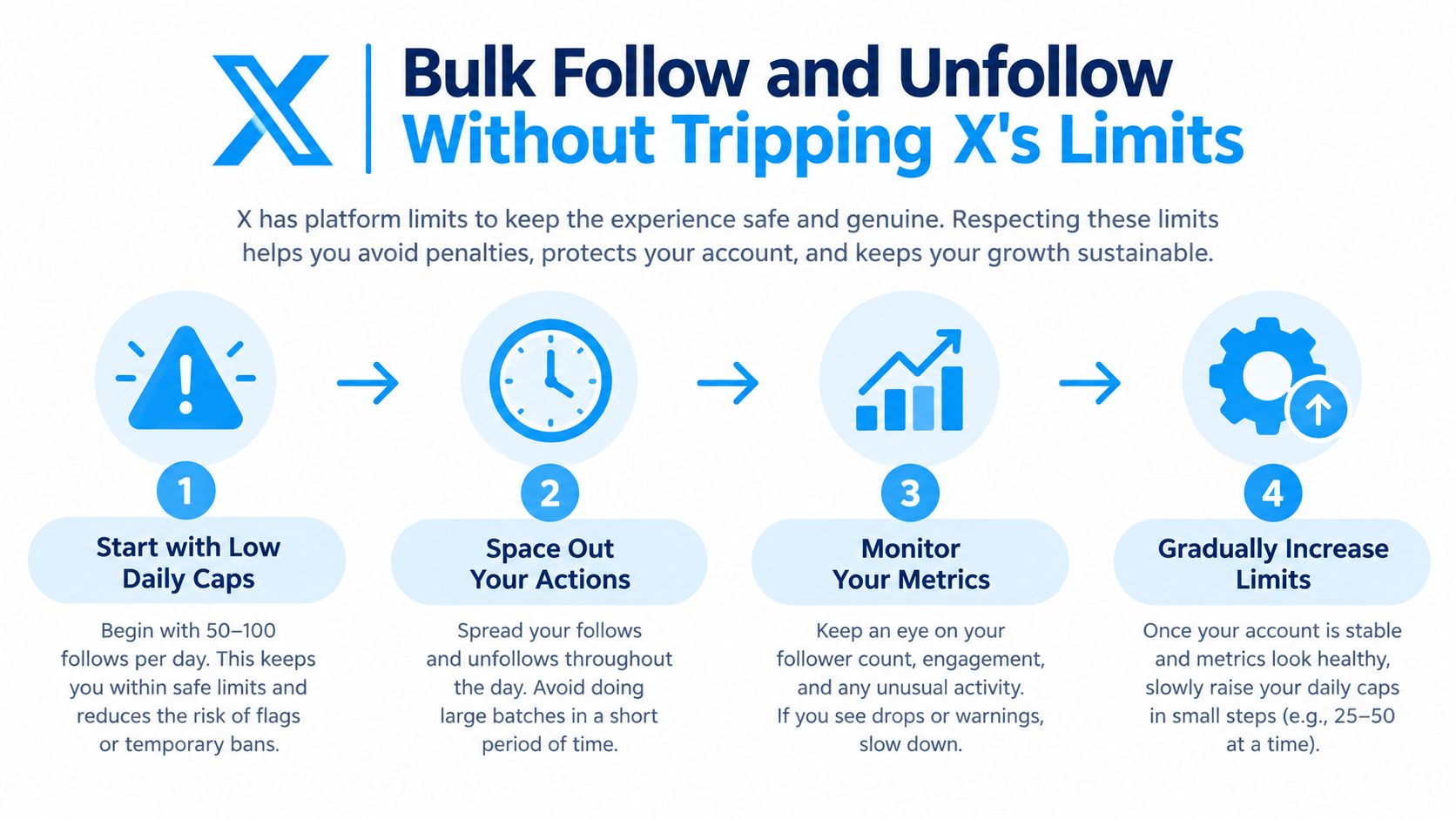
A new account can lose reach after a single aggressive follow campaign. Bulk actions work only when the account still looks like a person choosing relevant relationships, not a script repeating the same action.
For newer accounts, stay within roughly 50 to 100 follows per day and cap each batch at 25 follows, as described in the linked growth playbook. Spread batches across separate sessions rather than running one marathon. After a follow experiment, wait 48 to 72 hours before deciding whether to unfollow. That gives you time to see whether the account engages or fits your audience. These figures come from Nicole Smith's engagement playbook, which offers expert guidance on rapid social-media engagement.
Build a human-looking rhythm
Use staggered 15-minute windows instead of one action block. Open the target list, inspect every profile, follow only accounts that fit your topic, and record the source or campaign. A follow from a focused niche conversation deserves a different review from one generated by a broad discovery stream.
Keep unfollows inside a reviewed segment. An account that does not respond immediately may still be a reader, private user, or occasional participant. Separate irrelevance, inactivity, and abuse, then assign each category a different response. Relevance usually calls for retention, inactivity calls for monitoring, and abuse calls for removal.
Queueing and analysis tools change over time, so check current access before connecting an account. TweetDelete, Followerwonk, and Circleboom may support different parts of the workflow. The native X interface remains suitable for smaller lists where each decision needs manual inspection. Guidance on implementing effective Twitter growth strategies is useful when automation supports relevance instead of replacing judgment.
Watch for throttling signals
Pause an action campaign if follows fail repeatedly, follow controls disappear, or impressions drop unexpectedly. Repeated retries through several tools can turn a temporary warning into a broader account problem. Stop the queue, preserve scheduled content, review recent activity, and resume gradually only after normal behavior returns.
For a practical relationship workflow, review Twitter follow and unfollow. The operating rule is simple: automate repetitive observation, not indiscriminate behavior.
Spotting Bots and Spammers Before They Drag Down Your Metrics
Bot detection is a judgment problem. No single profile signal proves that an account is fake, and legitimate users can have unusual posting habits, minimal bios, or imbalanced follower relationships.
Start by looking for clusters of evidence. An account with a generic avatar alone may be real. An account with a generic avatar, copied promotional posts, keyword-stuffed biography, no meaningful profile context, and repetitive replies deserves closer review. Geography can help identify mismatches, but it shouldn't become a shortcut for excluding people from a market.
Use a tiered review system
| Signal | Weight | Check Method |
|---|---|---|
| Repetitive promotional replies | High | Read recent replies and look for copied or near-identical language |
| Profile lacks credible context | Medium | Inspect the bio, links, avatar, posts, and conversation history |
| Sudden bursts of similar activity | Medium | Compare posting patterns across recent content |
| Strong mismatch with your niche | Low to medium | Compare topics, language, location, and audience fit |
| Unusual follower and following relationship | Low alone | Treat it as a prompt for manual review, not a verdict |
Obvious spam, scams, impersonation, and abusive automation can be blocked. Suspicious but not conclusive profiles can be muted or placed in a private review list. Ambiguous accounts should remain untouched until their behavior provides more evidence.
Protect the metric, not just the feed
X periodically purges spam and inauthentic accounts, which can make follower totals fall suddenly. Independent coverage cited in the brief also estimates automated accounts at roughly 9% to 15% of X's user base, with higher inauthentic shares around some hot topics, as discussed in coverage of Twitter follower bots. Treat that estimate as context, not as a reason to label any particular follower automatically.
The operational impact is more important than the label. A follower total can remain stable while the audience becomes less responsive, and a purge can create churn that has nothing to do with your latest post. Track replies, meaningful interactions, follower losses, and audience fit together.
A short weekly sweep is enough for most operators. Review new followers, inspect suspicious reply patterns, and quarantine uncertain accounts. Don't optimize for a perfectly clean list. Optimize for a list whose behavior you can interpret.
Retention Tactics That Keep Real Followers From Slipping Away
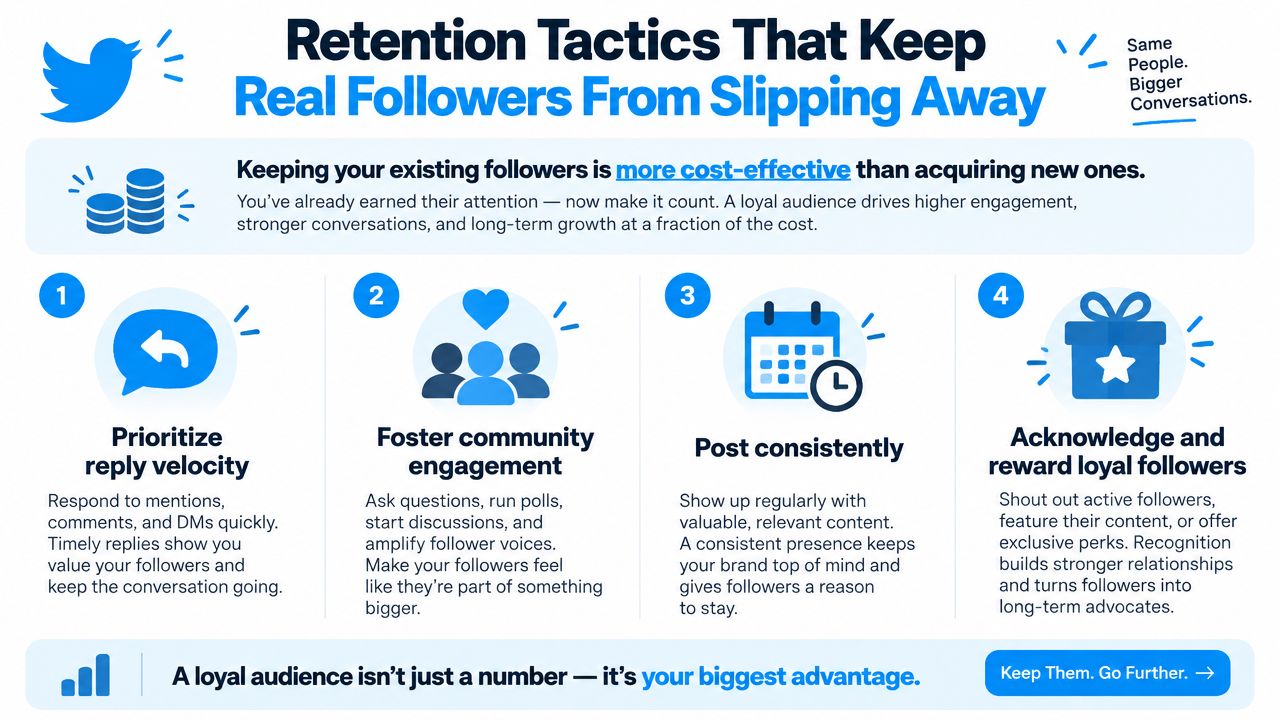
A follower count can rise while the audience becomes harder to reach. Retention starts by giving the right people a clear reason to return, then separating genuine churn from bot noise and short-term attention.
Start the conversation around each post. An engagement playbook for creators recommends engaging with other creators' content about 10 minutes before posting and replying to comments within 15 minutes after publishing to build early momentum. It also advises tracking engagement rate, retention rate, and content-level responses instead of relying on vanity metrics. See Nicole Smith's engagement playbook for that workflow.
Give followers repeatable reasons to return
Build a small set of dependable content roles instead of publishing disconnected thoughts:
- Teaching: Explain a process, decision, or mistake readers can apply.
- Conversation: Ask a focused question or join an active discussion in your niche.
- Evidence: Share a result, observation, teardown, or behind-the-scenes decision.
- Continuity: Use recurring formats, such as a weekly recap or running build log.
Short-form, interactive content can outperform static posts substantially. One industry guide reports 2 to 8 times higher engagement for short-form video than static content, as summarized in Sprinklr's social media management guidance. Treat that comparison as a testing prompt, not a universal benchmark. Compare formats within your own audience and keep the formats that produce meaningful replies, saves, and repeat attention.
Make response speed part of the content
A post loses social value when the author disappears while the conversation develops. Set an engagement window around publication, answer useful replies, and turn strong questions into follow-up posts. Keep high-value responses human, even if scheduling and monitoring tools handle routine discovery.
Use Twitter unfollower tracking methods to identify patterns over time. Compare follower losses with topic changes, posting gaps, and acquisition sources. Someone who leaves after a content shift may be signaling a fit problem, not exposing a failure in the account.
Retention also requires restraint. More posts do not automatically produce stronger loyalty, and aggressive outreach can attract people who never belonged in the audience. Keep the account's promise consistent, respond to readers, and judge growth by the quality of the people who stay.
Your Weekly Twitter Followers Management Routine
A useful routine should fit on the calendar, not live in a document you never open. Reserve one recurring slot, use a desktop browser for the audit and list work, and keep the same spreadsheet or dashboard open each week. Consistency makes changes easier to interpret.
The first 10 minutes for the audience snapshot
Record the current follower total, new followers, unfollows, and net change. Compare the latest follower export or tracker snapshot with the previous one. Mark suspicious-account movement separately so a bot purge doesn't get confused with content-driven churn.
Log the ratio of suspicious accounts as a directional review measure, not a claim of perfect classification. If the ratio rises, inspect the source of recent follows before changing your content or outreach.
The next 15 minutes for high-intent conversations
Open saved searches, mentions, replies, and notifications. Prioritize questions, objections, customer references, and posts from people in your target niche. Reply manually to conversations where context matters, then save promising accounts to the relevant list.
This block is about retention and discovery at the same time. You're showing existing followers that the account responds, while finding people who may become valuable future readers.
Another 15 minutes for list maintenance
Add new high-fit accounts, remove accounts that no longer belong in a segment, and move uncertain profiles into the review list. Keep list names stable and rules simple. If you can't explain why an account belongs in a list, the segment probably needs a clearer purpose.
15 minutes for relationship actions
Run reviewed follow or unfollow actions inside your conservative daily limits. Use small batches, inspect profiles, and record the reason for each action. If the account shows throttling signs, skip this block rather than forcing the queue.
The final five minutes for retention checks
Review unanswered replies, useful quote-post opportunities, and outstanding direct messages. Confirm that scheduled posts still match the account's current themes. Finish by logging follower delta, engagement rate, bot ratio, and list coverage in the same place.
The loop closes when the next week's audit begins with a comparable snapshot. Over time, that record separates real audience growth from churn, cleanup events, and low-quality acquisition. XBurst offers follower and unfollower tracking, bulk unfollow workflows, follower-change analytics, engagement monitoring, and scheduling in a workflow designed for X operators. If that combination fits your process, visit XBurst and evaluate it alongside the rest of your stack.