
What Do the Emoji Smiley Faces Mean and How to Use Them
Learn what do the emoji smiley faces mean, from 😊 to 😁, and how tone shifts across platforms, generations, and professional contexts on X.
Have you ever sent a smiling emoji to sound friendly, only to wonder whether the other person read it as cold, sarcastic, or dismissive? That uncertainty reveals the problem with most emoji guides. They tell you what a face is called, but not whether your reader will interpret it the way you intend.
The practical meaning of a smiley depends on three things: the face itself, the way it appears on the recipient's device, and the relationship surrounding the message. A 🙂 in a relaxed reply to a familiar follower can feel gentle. The same symbol after a correction, complaint, or delayed request may sound passive-aggressive.
If you're posting on X, that distinction matters. Short messages leave little room for tone, so an emoji can act like a quick facial expression, a joke marker, or a cushion around a request. Used carefully, it adds warmth. Used automatically, it can make a clear message harder to trust.
Why One Smiley Can Mean Three Different Things
What do the emoji smiley faces mean if the same symbol can sound warm, cautious, or sarcastic? A dictionary-style definition cannot answer that alone. Readers process a smiley beside the words, the platform's artwork, and their relationship with the sender.
Consider three messages: “Great job 😊” reinforces praise. “Can you fix this today 🙂” makes a direct request gentler. “You missed the deadline 🙂” may sound pointed, particularly between people already in conflict. The character stays the same, while its speech act, the action performed by the sentence, changes.
The definition lens
Begin with the broad emotional signal. Smiling eyes usually suggest warmth or happiness. A wide grin often feels more energetic, while tears of joy make laughter unmistakable. These cues provide a starting point, not a final interpretation.
A smiley can also do conversational work. Research on workplace email identifies three functions: expressing a positive attitude, signaling humor or irony, and acting as a pragmatic hedge that softens a request or correction. Research on how smileys soften or sharpen sentences in workplace email explains why a smiley can change the force of a sentence instead of merely showing the sender's mood.
The device lens
Unicode standardizes the underlying character, not a single universal illustration. Apple, Google, Microsoft, Samsung, and other platforms may draw different eyes, mouths, colors, or proportions. A subtle expression can arrive on another screen looking warmer, flatter, or less familiar. If a post on X depends on a tiny facial detail, the rendering itself may weaken your intended tone.
The audience lens
Readers bring expectations shaped by age, culture, earlier messages, and power relationships. A familiar follower may read 🙂 as gentle encouragement. A new customer may find it too casual. Someone who already feels annoyed may treat the same face as proof that you are dismissing the issue. Age can reverse expectations too, so a smiley that feels harmless to one generation may sound strained or sarcastic to another.
Context acts like a filter over the symbol.
Practical rule: Read the sentence without the emoji, then read it with the emoji. If the second version changes the message more than intended, replace the face with explicit wording.
The better question is not “What does this emoji mean?” but “Will my reader interpret this combination of words, artwork, and relationship as I intend?” That question works better for replies and short posts, where one small symbol can carry more tone than the surrounding text.
How Smiley Faces Became Tone Carriers
The smiley didn't begin as a colorful face on a phone. It began as a solution to a text problem: written messages don't show whether a sentence is serious, playful, or ironic.
On September 19, 1982, Carnegie Mellon computer scientist Scott Fahlman proposed :-) to mark humorous messages and distinguish them from serious ones. The small sideways face supplied a missing social cue. It told readers how to approach the sentence, not just what the sentence literally said.
The visual smiley followed a different path. American graphic artist Harvey Ross Ball created the familiar yellow smiling face in 1963 for an employee-morale campaign. That design made the smiley recognizable as a cheerful symbol outside a computer screen, but it still functioned as a general emotional signal rather than a detailed portrait of a particular person.
From pictures to shared characters
Modern emoji developed later in Japan. Shigetaka Kurita designed an early 176-character set in 1999 for NTT DoCoMo's i-mode mobile service. These characters could communicate weather, objects, actions, and feelings in a compact format suited to mobile messages.
The important shift came when emoji became interoperable. Emoji were incorporated into Unicode 6.0 in October 2010, allowing the same underlying character to travel across systems, even though each platform could draw its own artwork. This history of emoji explains why a smiley is both standardized and visually variable.
That history explains why fixed definition lists are limited. A smiley is not a facial photograph. It's a tone carrier, a compact cue that readers interpret through language and situation. The character's official identity provides a baseline, while rendering and context add the social meaning.
For an X creator, this is similar to writing in a recognizable voice. Word choice, punctuation, sentence length, and timing all shape how a post feels. Your writing style analysis can help you notice those patterns, but no style label can predict every reader's reaction. Emoji work the same way. They support a voice, but they don't replace judgment.
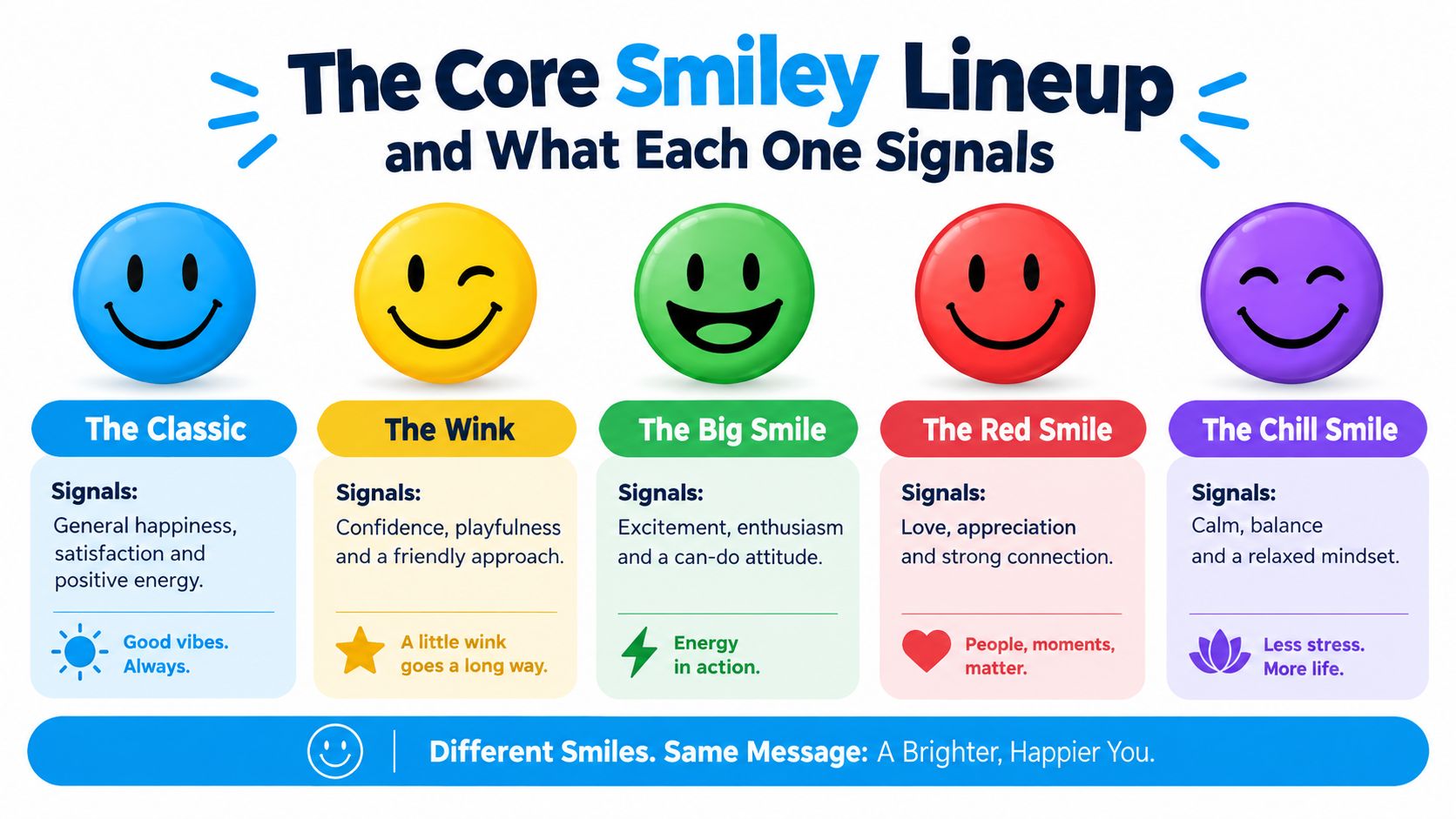
The Core Smiley Lineup and What Each One Signals
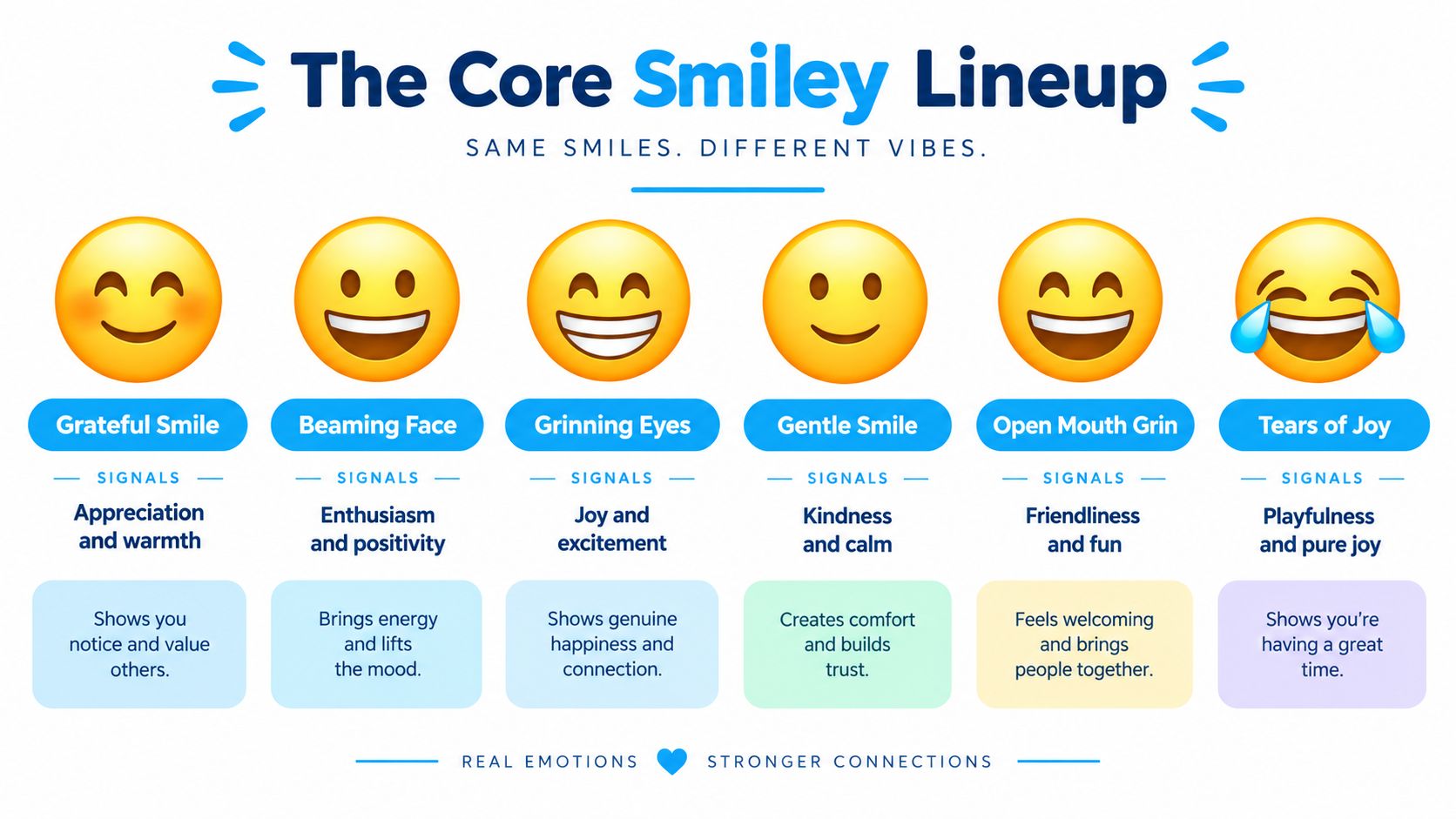
The six faces below form a useful working vocabulary for everyday X posts and replies. Their meanings overlap, so treat each description as a likely reading, not a permanent translation.
😊 Smiling face with smiling eyes
This face usually communicates warmth, gratitude, and sincere friendliness. The smiling eyes make it feel more personal than a simple curved mouth. Use it after thanks, encouragement, a welcoming reply, or good news that deserves calm positivity.
“Thanks for sharing this 😊” feels appreciative without becoming loud. Compared with 🙂, 😊 usually carries more visible emotional investment.
😀 Grinning face
😀 has an open mouth and a straightforward expression. It often reads as general happiness, welcome, or uncomplicated enthusiasm. It works for a cheerful greeting or a plainly positive reaction.
“Good morning, everyone 😀” is brighter and more open than “Good morning, everyone 🙂.” The difference is small, but the open mouth gives the first message more energy.
😁 Beaming face with smiling eyes
😁 displays a broad grin and can suggest pride, excitement, or strong satisfaction. It fits moments when you're pleased with an outcome, celebrating progress, or sharing a win.
“We shipped the update 😁” sounds more triumphant than “We shipped the update 😊.” Use it when the enthusiasm is genuinely part of the message, not when you're discussing a sensitive problem.
🙂 Slightly smiling face
🙂 is the most context-sensitive member of this group. Its restrained smile can signal mild positivity, politeness, or conversational softening, but it may also sound clipped, ironic, or passive-aggressive.
“Sounds good 🙂” might mean sincere agreement between friends. In a public professional thread, it can feel like the sender is ending the exchange without enthusiasm. After criticism, its ambiguity becomes even more noticeable.
😄 Grinning face with smiling eyes
😄 combines an open grin with smiling eyes, so it tends to signal joy, delight, or energetic warmth. It's stronger than 😊 and often more expressive than 😀 because the eyes reinforce the emotion.
“Your explanation helped a lot 😄” sounds openly delighted. If the subject is routine or serious, that energy may feel mismatched, so choose it when the surrounding words can support the enthusiasm.
😂 Face with tears of joy
😂 makes laughter the central message. It usually means strong amusement, not merely happiness. The tears tell the reader that the sender found something funny or absurd.
Use it with a joke, a playful observation, or an unexpectedly funny reply. It's a poor fit for bad news, customer frustration, or a serious correction because the laughter can overpower the words.
A useful contrast: 😊 adds warmth, 😄 adds lively joy, and 😂 makes amusement unmistakable. 🙂 stays restrained, which is exactly why it needs the most contextual care.
Usage research supports the idea that these faces belong to a broader positive family, while still showing that emoji use varies by setting. In clinical text messages, 😊 appeared 10 times, or 9% of coded emoji instances, while 😂 accounted for 6%; the figures come from the review of emoji communication. Cross-national research across six countries also found that faces representing joy, sadness, anger, surprise, and neutrality were generally interpreted according to their intended emotional categories, independent of age and gender.
The practical lesson is not to memorize a perfect hierarchy. Ask what the sentence needs. If the words already express excitement, a gentle 😊 may keep the tone balanced. If the post is playful, 😂 can make the intent clearer. If you're writing a brief agreement to someone you don't know well, explicit words may be safer than relying on 🙂.
Why the Same Smiley Looks Different on Every Phone
Unicode gives devices a shared character to transmit, but it doesn't force every company to draw that character identically. Apple, Google Android, Samsung, Microsoft, and other platforms create their own visual versions. The same code can therefore arrive with a different mouth curve, eye shape, head angle, or overall expression.
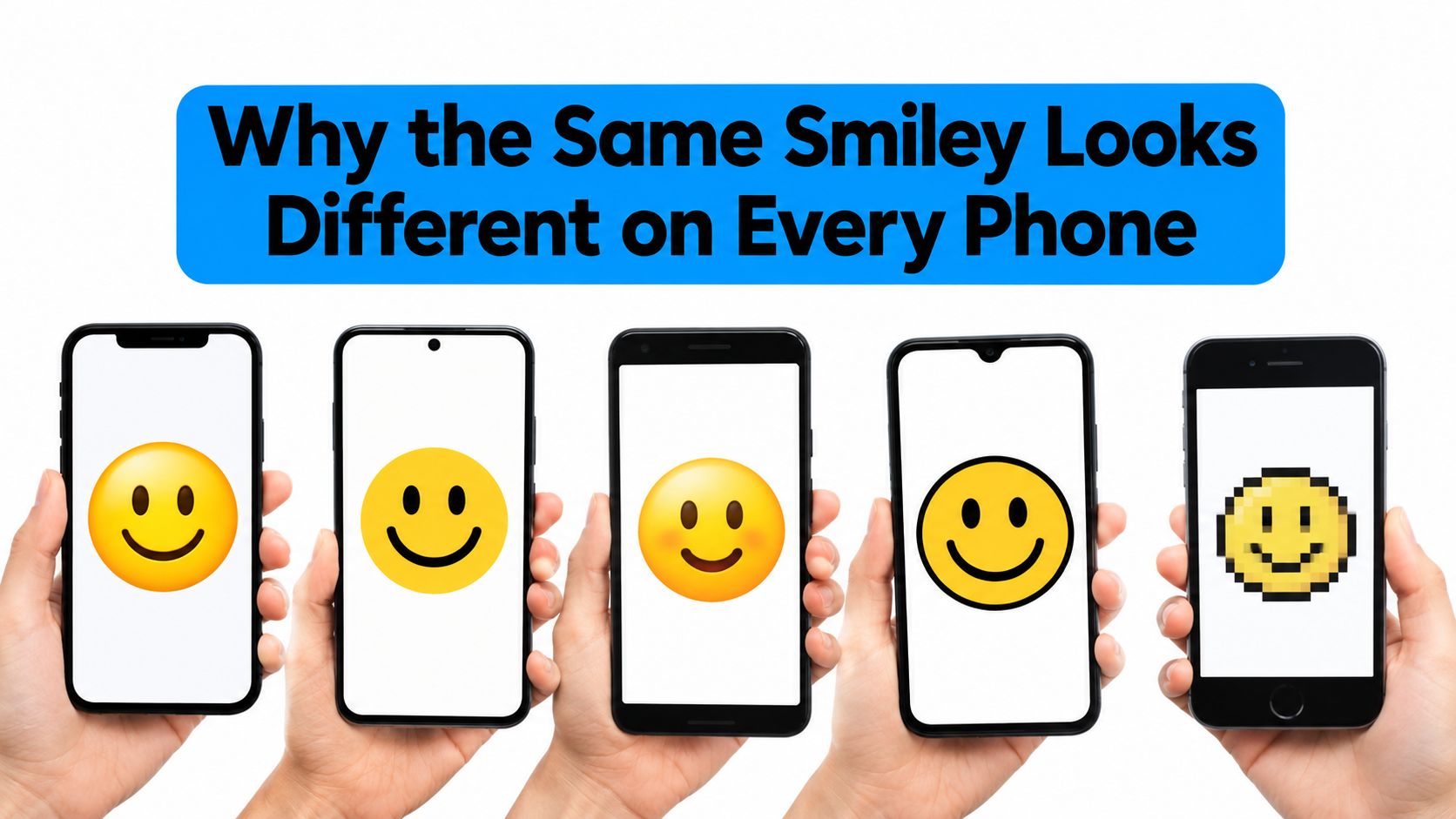
That difference matters most for subtle faces. A broad grin remains broadly positive across many designs. A restrained smile has less emotional information, so even a small change in the mouth or eyes can alter the impression. One version may look gentle. Another may look blank, forced, or faintly amused.
Official name versus perceived emotion
An emoji's Unicode name gives you a technical label, not a promise about the reader's reaction. “Slightly smiling face” describes the character category, but it doesn't guarantee that every user will experience the face as friendly.
Research found that emoji faces are not anatomically equivalent across platforms, and only three faces were consistently perceived as happy across Apple, Google Android, and Samsung: 😂, 😊, and 😄. The platform comparison study also highlights how visual differences can create communication errors.
That finding suggests a practical risk scale:
- Clear emotional faces: Broad smiles and visible laughter are easier to interpret across devices.
- Subtle expressions: Mild smiles depend more heavily on mouth and eye design.
- High-stakes messages: Any face can become risky when the reader needs precision rather than mood.
What this means for X
Your audience may include people using phones, desktop browsers, older operating systems, or different platform fonts. You can't control the artwork they see, so don't make an important distinction depend on a small facial detail.
If you write “We've corrected the billing issue 😊,” the words carry the core information and the emoji adds warmth. If you write only “Fine 🙂,” the character carries almost all the tone, leaving the reader exposed to rendering differences and personal interpretation.
Message reliability beats visual cleverness. Choose a face that supports the sentence, then make sure the sentence still works if the emoji looks different or disappears entirely.
For public posts, prefer clearly positive faces when an emoji genuinely helps. For technical corrections, customer escalations, investor updates, and cross-platform announcements, plain language is usually more dependable than a nuanced smile.
When a Friendly Smiley Actually Hurts Your Message
Could a smiley intended as kindness make your message seem less appropriate or competent? In formal communication, yes. An emoji can signal friendliness to the sender while making the recipient question the sender's judgment or professionalism.
A workplace study involving more than 500 participants from 29 countries found that smileys in formal workplace messages did not increase perceived warmth. Instead, they lowered perceived competence, and that lower competence perception reduced recipients' willingness to share information, according to the reported workplace findings.
Context changes the result. In informal communication, the same competence penalty was not comparable, and a smiley could increase perceived warmth. The emoji is less like a fixed translation and more like a tone setting. The surrounding relationship determines how the reader hears it.
Four situations that deserve caution
First contact leaves little room for interpretation. A potential customer, journalist, investor, or unfamiliar professional does not yet know your usual style. A smiley that feels natural to you may seem too casual before rapport exists.
Criticism creates a sharper risk. “The figures in this post are incorrect 🙂” pairs negative words with a positive face. That mismatch can sound mocking, superior, or sarcastic rather than helpful.
Customer escalations call for recognition before levity. A frustrated person may read a smiley as an attempt to minimize the problem. Clear acknowledgment and a concrete next step usually repair the interaction more effectively.
Inconvenient requests can also become awkward. “Can you send that again today 🙂” may be intended to soften the request, yet the cheerful face can make the sender appear insincere about imposing on someone.
The generational reversal
Age-related expectations make 🙂 particularly unstable. Many readers still interpret the classic smile as straightforward friendliness, while younger users may use it to suggest sarcasm or passive aggression. These are tendencies, not rules for every person, but they create a genuine risk of mismatch.
58.4% of surveyed respondents reported experiencing emoji-related miscommunication, a finding covered in the same source. Treat that figure as a warning for mixed audiences. A familiar symbol does not have one universal social meaning.
| Message situation | What the sender may intend | What the reader may infer |
|---|---|---|
| “We've already sent the file 🙂” | Friendly reminder | Blame or impatience |
| “Please review the correction 🙂” | Softened request | Condescension or sarcasm |
| “That's disappointing 🙂” | Emotional restraint | Passive aggression |
| “Thanks for catching that 😊” | Genuine appreciation | Usually clear warmth |
Use the sentence as the foundation and the emoji as a small finishing detail. Don't use a smiley to disguise a sentence that needs better wording. Rewrite the message so it sounds respectful without the symbol. Add the emoji only if it contributes warmth without creating a second possible meaning.
Choosing the Right Smiley for Replies and Posts on X
Ask what the reader is likely to infer, not only what you intend. A public reply to a familiar community member allows more playful warmth than a first-contact pitch or a response to a complaint. The same emoji works like a small tone cue, and the surrounding relationship determines how that cue is read.
| X Scenario | Safer Smileys | Smileys to Avoid | Why |
|---|---|---|---|
| Community reply to a familiar follower | 😊, 😄 | 🙂 after disagreement | Rapport makes warmth easier to read |
| Light praise or congratulations | 😄, 😁, 😊 | 😂 when the achievement is serious | Match the emotional intensity to the praise |
| Customer escalation or correction | Usually none | 🙂, 😂, 😁 | A positive face can minimize frustration |
| Investor, press, or first-contact post | Usually none, or a restrained 😊 only when clearly appropriate | 🙂, 😂, 😁 | Formal audiences may judge casual signals more harshly |
| Clearly playful joke among an established audience | 😂, 😄 | 🙂 if the joke could sound sharp | Make the humor visible rather than ambiguous |
Placement changes the emoji's role. At the end of a greeting, it can reinforce warmth. After a request, it can make the wording feel less direct. After criticism, it can introduce irony or make the message appear passive-aggressive. Those three functions, softening, signaling warmth, and marking irony, also apply to short replies on X.
A practical drafting test
Write the message without an emoji first. If the wording sounds abrupt, revise the sentence. Add the face only after asking whether it strengthens the relationship or conceals a sharp edge.
For a familiar community reply:
“That's a smart way to frame it 😊”
For a light joke:
“The spreadsheet has chosen chaos again 😂”
For a customer escalation, write directly:
“You're right to flag this. We're checking the issue and will update you here.”
The public setting adds another audience. A private DM can depend on shared history, while a public reply may be read by people who know nothing about the relationship. A sentence that looks dismissive when quoted without context is a poor place for an ambiguous smiley.
A deliberate reply-to-tweet workflow can help you assess the original post, the audience, and the intended tone before adding a visual cue. The goal is personality that readers can understand, not personality that requires private context to decode.
A Quick Mental Model for Posting on X
Keep three questions beside the compose box:
- What does the face generally signal? Choose the emotional category first. 😊 and 😄 usually provide clearer warmth than a restrained 🙂.
- How might it render? If the distinction depends on a tiny facial detail, assume some readers may see it differently.
- What does this relationship allow? Familiar community conversations can support more playfulness than complaints, first contact, or formal announcements.
Then apply one final test: would the sentence remain respectful and understandable without the emoji? If not, revise the words. An emoji should add tone, not carry the entire meaning.
For broad, cross-platform warmth, 😊 or 😄 are often more dependable choices. Treat 🙂 as ambiguous, especially after criticism or an inconvenient request. Skip smileys when the audience needs precision, accountability, or confidence more than friendliness.
A thoughtful content strategy for X treats emojis as small editorial decisions. The right face can make a reply feel human. The wrong face can make a clear sentence sound evasive. Meaning isn't a dictionary entry, it's a judgment call made between a sender, a screen, and a reader.
XBurst helps creators, founders, and brands find high-opportunity conversations, generate on-brand replies, and measure how posts and engagement perform on X. Visit XBurst to explore the platform and start a 3-day free trial for more consistent, intentional audience growth.