
Internet Slang AF: What It Means and How to Use It
Learn what internet slang AF means, where it originated, and how to use it properly on social media without offending your audience.
AF stands for “as fuck” and functions as an intensifier that amplifies the adjective it follows. Dictionary.com dates the recorded use of the abbreviation to approximately 2005–2010, while the longer phrase has a much older history.
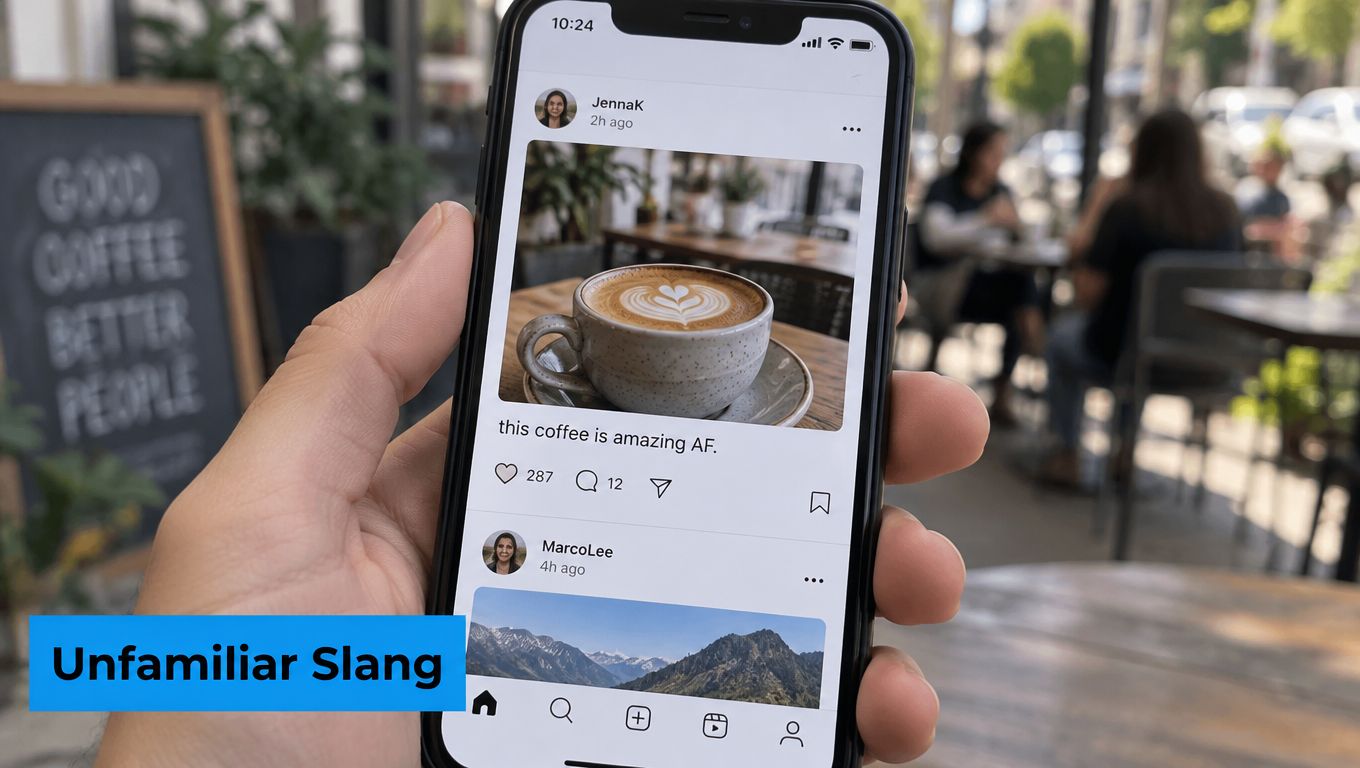
You're scrolling through Instagram or X when a caption stops you: “this coffee is amazing AF.” You understand amazing, but the final two letters make you pause. Is the writer being funny, rude, enthusiastic, or all three?
The answer depends on context. AF is internet slang used to intensify a description, usually in casual digital conversation. It can make “tired” sound extreme, turn “beautiful” into emphatic praise, or add dramatic force to a complaint. The abbreviation carries the vulgarity of its source phrase, even when readers experience it as a familiar online shortcut.
When You See AF in Your Feed
The coffee caption is a useful starting point. “This coffee is amazing AF” doesn't introduce a new fact about coffee. It pushes the writer's enthusiasm higher, making the drink sound exceptionally good in that person's experience. A friend might read the sentence as playful excitement, while a café manager might decide the wording feels too casual for an official brand post.
You may also see phrases such as:
- “tired AF”, meaning extremely tired
- “beautiful AF”, meaning strikingly beautiful
- “confusing AF”, meaning highly confusing
- “ready AF”, meaning very ready or fully prepared
The abbreviation usually follows the word it strengthens. It works most naturally in captions, replies, group chats, memes, and other spaces where people expect relaxed, expressive language. Its compact shape suits fast-moving platforms, where users often want to communicate attitude as much as information.
The important boundary is register. AF isn't neutral business English, and it isn't automatically friendly just because it appears frequently online. The source phrase is profane, so the abbreviation can feel bold, humorous, intimate, or inappropriate depending on who sees it. If you're building a digital voice, resources on small business AI insights can help you think more carefully about audience and communication choices, but the final judgment still belongs to the person posting.
What AF Actually Does in a Sentence
Consider the sentence “I'm busy AF.” Remove the abbreviation and you get “I'm busy.” The basic claim remains. AF adds force to the adjective, suggesting that the speaker feels an unusually high degree of busyness.
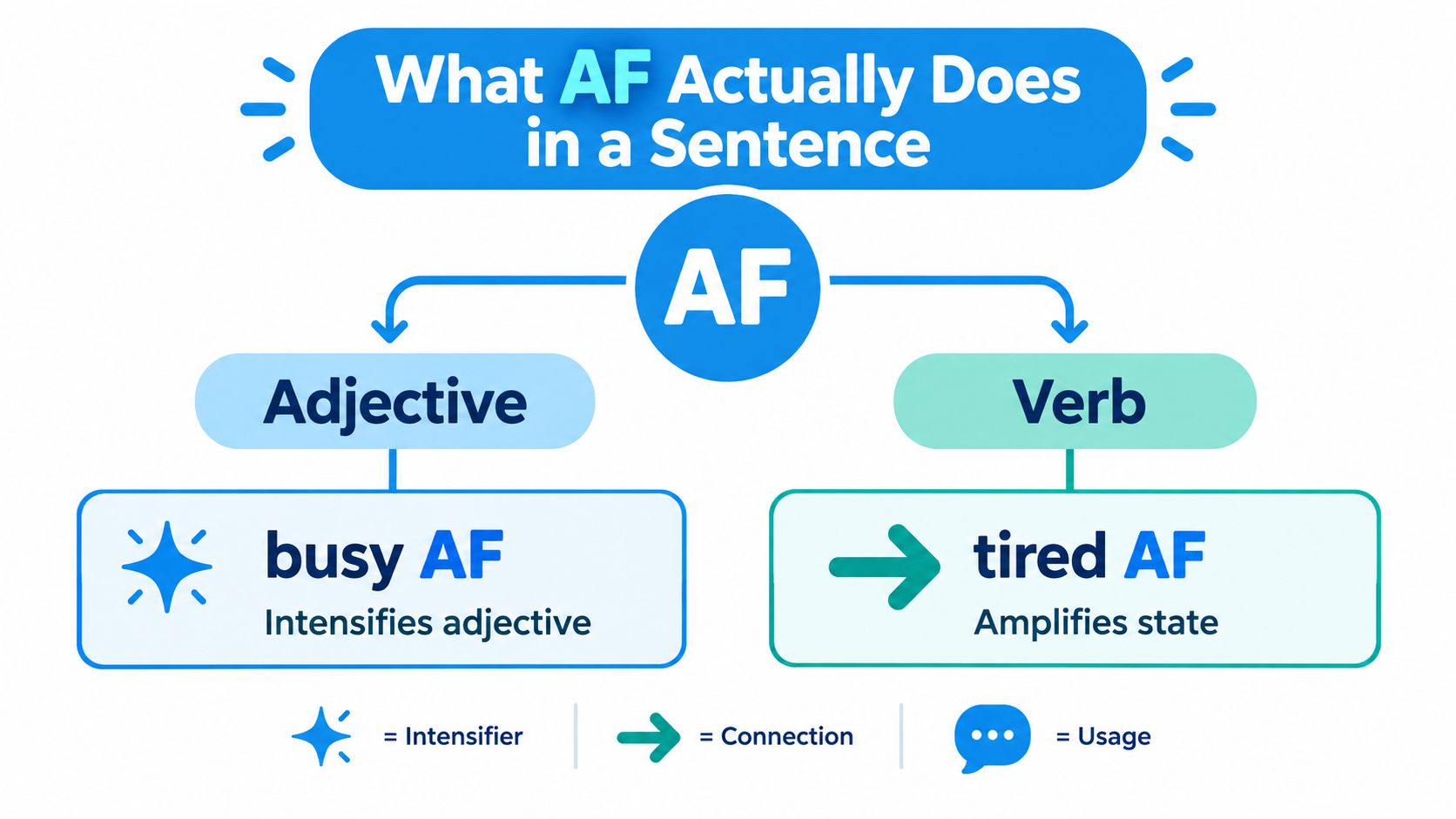
Linguistically, AF functions as a degree modifier rather than contributing new propositional content. In other words, “busy AF” amplifies the perceived intensity of “busy” while preserving the underlying truth of the statement, as explained in this analysis of AF as a pragmatic booster.
That distinction helps you avoid a common mistake. AF isn't itself a topic, emotion, or opinion. It doesn't tell you whether the writer feels happy or angry. The surrounding word and sentence provide that information.
| Phrase | What AF intensifies | Likely reading |
|---|---|---|
| “tired AF” | A physical or emotional state | Strong exhaustion |
| “beautiful AF” | A positive evaluation | Strong praise |
| “expensive AF” | A judgment about cost | Strong criticism or surprise |
| “funny AF” | An evaluation of humor | Strong amusement |
The same modifier can appear beside positive, negative, or neutral descriptions. A sentiment system that treats every occurrence of AF as automatically negative will miss that range. For content analysis, it's more accurate to treat AF as a context-sensitive intensifier and examine the words around it.
Writers can use the same principle. Before interpreting a post, identify the word AF modifies, then ask what the complete phrase is doing socially. A message saying “that joke was dark AF” may express admiration, discomfort, or both. A message saying “this update is confusing AF” may criticize a product, but it may also be a joking complaint between friends. For a deeper look at how language choices reveal personality and tone, see how to analyze writing style.
How Context Changes What AF Means
AF doesn't have one fixed emotional tone. It supplies intensity, while collocation, punctuation, capitalization, and audience determine how that intensity lands.
Start with the word before it. “Beautiful AF” usually reads as enthusiastic praise. “Tired AF” communicates exhaustion, often with a humorous edge. “Rude AF” can describe behavior sharply, and it may sound more hostile when directed at a real person rather than an abstract situation.
Read the surrounding words
A practical reading sequence works well:
- Find the modified word. Is it “amazing,” “late,” “awkward,” or “angry”?
- Identify the target. Is the writer describing themselves, an object, an event, or another person?
- Check the punctuation. “Beautiful AF!” feels energetic. “Beautiful AF.” may sound drier or more deliberate.
- Look for nearby signals. Emojis, laughter markers, exaggeration, and playful images can soften the phrase.
- Consider the relationship. Friends may use AF affectionately, while the same wording from a stranger can feel aggressive.
Capitalization changes emphasis, but it doesn't create a new dictionary meaning. AF looks standard and visually prominent. af often feels more casual and text-like. A.F. can appear stylized or deliberately old-fashioned, though readers may still understand the same underlying expression.
Platform norms matter too. A private group chat usually gives participants more room for profanity and teasing than a public customer-service reply. A creator addressing a familiar community may use AF to signal closeness. A company using it without knowing its audience may sound like it's copying slang rather than speaking naturally.
Research summarized in a study of internet slang identifies informality and expressive language as dominant functions, while group- and subject-restricted forms accounted for 26% of observed properties and time-restricted, ephemeral, and local usage accounted for 21.4% (study of slang properties in online communication). Those figures support a useful caution: a term's popularity doesn't guarantee that every audience shares its meaning or comfort level.
Reading rule: AF tells you “strongly.” The word, target, and relationship tell you whether “strongly” sounds funny, admiring, critical, or threatening.
Where AF Came From and Why It Spread
AF feels modern because people encounter it in captions, comments, and messages. Its source phrase is older. Merriam-Webster records “as fuck” in print from at least the early 1970s and in rap and hip-hop lyrics from at least the 1980s (Merriam-Webster's history and definition of AF).
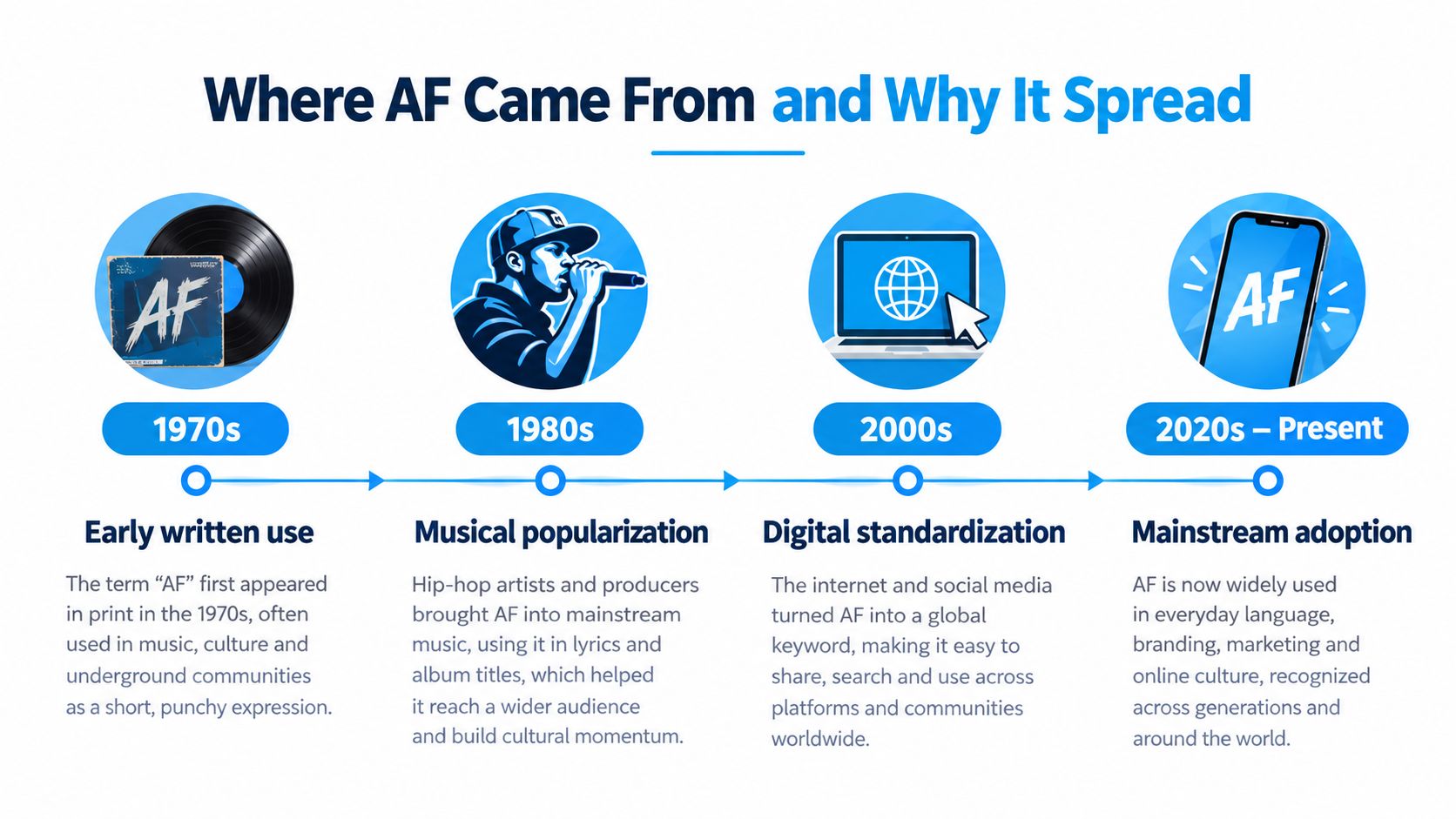
The abbreviation represents a change in format, not the invention of the intensifier itself. Spoken language and music gave the longer expression a recognizable role. Online communication then shortened it into a compact written form that could move easily through texts, posts, replies, and product names.
A shift from phrase to shorthand
The recorded history shows a gradual transition:
- Early print and musical use: The full intensifier already existed in written and spoken culture.
- Digital abbreviation: AF offered a shorter alternative for users communicating quickly online.
- Platform circulation: Repeated use in public posts helped readers recognize the letters without needing the phrase spelled out.
- Mainstream visibility: Commercial and everyday uses made the abbreviation familiar beyond private messages.
The abbreviation's online identity developed alongside the social-media era. Wiktionary documents a Twitter example dated April 6, 2009, and Urban Dictionary's earliest reported definition specifically for AF appeared on October 10, 2011 (Wiktionary's documented usage and timeline). A 2015 BuzzFeed poll found that pronouncing the letters “ay-eff” was almost twice as popular as saying “aff,” suggesting that many users treated AF as a distinct written item rather than merely an abbreviation read through the original phrase. By 2017, language observers had noted the abbreviation in commercial contexts.
This history explains why AF can feel both established and contemporary. The intensifying function is familiar, but the two-letter form belongs strongly to online English. Compact expressions thrive where people write quickly, perform identity, and rely on shared cultural knowledge. AF spread because it does several jobs at once: it saves space, signals informality, and adds emotional volume without requiring a longer explanation.
When to Use AF and When to Avoid It
The right question isn't whether AF is “good” or “bad” language. The useful question is whether the abbreviation matches the audience, relationship, purpose, and platform.
| Situation | Possible effect of AF | Safer choice |
|---|---|---|
| A personal caption about an outfit | Energetic, playful emphasis | AF may fit |
| A message in a close group chat | Familiar and humorous | AF may fit if the group uses it |
| A public reply to a customer | Overly casual or disrespectful | Use “very” or a specific description |
| A formal business update | Unprofessional or distracting | Choose precise standard wording |
| Family-oriented communication | Potentially inappropriate | Avoid the profanity-based shorthand |
| An academic or official document | Mismatched register | Use formal degree modifiers |
AF can work when a creator already has an informal voice and the audience understands that voice. “This launch is exciting AF” may feel natural in a community post built around humor and enthusiasm. The same sentence in an investor update, support email, or policy document would distract readers from the message.
Audience familiarity is especially important across cultures and demographics. Online English travels widely, but slang carries social history and group associations. A reader may understand the literal meaning while still judging the phrase as crude, performative, or exclusionary. The abbreviation's history is rooted particularly in African American English, hip-hop, texting, and social-media communication, so responsible use requires more than copying a phrase that appears popular.
Compare the alternatives
If you want intensity without profanity, try:
- “extremely useful” instead of “useful AF”
- “seriously impressive” instead of “impressive AF”
- “far too complicated” instead of “complicated AF”
- “very busy” instead of “busy AF”
These alternatives don't carry the same internet-slang identity, but they make your intent clearer to a wider audience. For visual or creative projects where you want strong impact without crossing audience boundaries, guidance on creating safe dramatic effects offers a useful parallel: dramatic communication still benefits from deliberate control.
Brand teams should also review the rest of their voice. A single casual phrase can feel authentic when it matches the brand's established personality, but forced slang can make a post sound like imitation. Examples of individual branding can help creators compare distinctive voices and decide whether an edgy shorthand belongs in their own communication.
If you wouldn't use the full phrase with that audience, don't assume the abbreviation makes it harmless.
Quick Checklist for Using AF Responsibly
Before you type AF into a caption or reply, run through a short decision test. You don't need to become a slang historian. You need to know what you're intensifying and who will read it.
- Name the base word. Write the phrase without AF. If “tired,” “beautiful,” or “confusing” already expresses the idea, AF should only increase its force, not change the message.
- Check the target. “I'm tired AF” focuses on the speaker's state. “You're rude AF” targets another person and can sound confrontational.
- Read the tone aloud. Notice whether the sentence sounds excited, comic, irritated, or hostile. Punctuation and capitalization can sharpen that impression.
- Match the setting. Casual chats and personal social posts allow more expressive language. Formal emails, academic writing, customer support, and family-facing communication usually call for a cleaner alternative.
- Consider shared language. If the audience doesn't normally use internet slang, the abbreviation may create distance instead of connection.
- Use one clear signal. Avoid stacking several slang expressions into one sentence. Readers shouldn't have to decode your tone before they understand your point.
- Choose a substitute when uncertain. “Extremely,” “strongly,” “seriously,” or “very” can preserve emphasis without the profanity.
A quick final test is to ask, “Would this still sound natural if I wrote the full phrase?” If the answer is no, the shorthand may be doing too much work. If you want to apply the same judgment to short-form posts, how to write tweets provides a broader framework for making concise language clear and intentional.
The best use of AF is deliberate rather than automatic. Let the surrounding words carry the meaning, let the audience guide the register, and remember that familiarity with slang never removes the need to read the room.
XBurst helps creators, founders, and brands build an authentic presence on X with on-brand AI replies, writing-style analysis, conversation discovery, scheduling, and engagement analytics. Visit XBurst to explore the platform and start turning clearer language choices into more consistent audience engagement.