
Twitter Algorithm Explained: How X Ranks Content
Get the Twitter algorithm explained in plain English. Discover how X ranks content, the signals that drive reach, and actionable strategies
Most advice about the Twitter algorithm explained online starts with the wrong question. It asks how to get more likes, as if X were a popularity contest with a single scoreboard. The more useful question is: which actions does the recommendation system predict a user will take, and how does a post move through the ranking pipeline before it reaches that user?
X doesn't publish every post to every follower in time order. It retrieves candidates, scores them with machine-learning models, applies filtering and mixing rules, then selects what appears on screen. That means a post can earn attention because it generates a reply, profile visit, click, or meaningful reading time, even when it doesn't produce the largest visible like count.
The practical shift is important for creators and founders. Instead of optimizing only for publication time or surface-level reactions, you can design content around relevance, early interaction, conversation, and sustained attention. The same principle applies across social platforms, although each feed uses different signals. For a broader comparison, these LinkedIn algorithm tips for creators offer useful context on how recommendation systems shape professional content.
The Shift From Chronological to Predictive Relevance
The biggest mistake in understanding Twitter's algorithm is treating the feed like a clock. Chronological delivery answered one question: which post was published most recently? Predictive delivery asks a harder one: which post is this person most likely to value?
For years, Twitter worked much like a live news ticker. If you followed an account, its latest post generally appeared above earlier posts, and publication time determined much of the timeline's order. That approach became less useful as more posts competed for attention. A user returning after a break could face a backlog, while a valuable post might vanish before the reader encountered it.
In 2016, Twitter changed its default experience to “show me the best tweets first.” The timeline began ranking recent posts by predicted relevance and engagement, using signals such as recency, prior interaction with the author, and engagement from other users. The transition is covered in coverage of Twitter's timeline algorithm transition.
The difference shapes content strategy. Chronological distribution prioritizes publication time. Predictive distribution prioritizes the probability that a particular user will read, respond to, click, or otherwise find a post useful.
The feed isn't a clock. It's a prediction.
Recency still matters because new posts enter a competitive pool, and early timing can affect who encounters them first. It is one input among several, rather than the final sorting rule.
According to X's open-sourced architecture documentation, the ranking system employs thousands of features and a neural network with roughly 48 million parameters, as described in this account of X's ranking architecture. The practical lesson is simpler than the infrastructure: X estimates future behavior from many signals instead of merely counting completed likes.
That same principle applies beyond Twitter. Creators who understand what AI means in social media can separate durable ideas, such as relevance and audience feedback, from tactics that may change with each platform update. For comparison, these LinkedIn algorithm tips for creators show how recommendation systems also shape professional content.
Inside the Multi-Stage Recommendation Pipeline
A post does not move directly from publication to the top of a user's feed. X processes it through several gates, each answering a different question: can this post interest the user, is it likely to prompt a useful action, and should it appear under the feed's filtering rules?
The pipeline begins with a vast pool of possible posts. A retrieval system narrows that pool to a smaller candidate set, reportedly about 1,500 posts, before later ranking stages, as described in this breakdown of the X recommendation pipeline. That figure represents the candidate stage, not the number of posts a user ultimately sees.
Stage one retrieves possible posts
The retrieval layer searches for posts that fit a user's interests. It can draw from followed accounts, posts linked to earlier interactions, and topics reflected in prior behavior. Following an account may help a post enter consideration, but it does not guarantee prominent placement.
The system combines activity across multiple surfaces. Likes, replies, clicks, profile visits, and reading behavior create a working profile of what a user tends to respond to. Someone who regularly reads product research posts may therefore receive relevant content from an unfamiliar account, even when that account has a smaller follower graph.
If you're studying how content surfaces are curated, this content suggestion engine breakdown maps the process in detail.
Stage two scores candidates
After retrieval, machine-learning models score candidates using explicit and implicit signals. X's engineering documentation describes a two-stage ranking design and a signal service that collects user actions across surfaces in the X engineering overview of the recommendation algorithm.
The model scores each candidate against predicted user actions, negative-feedback risk, and relative relevance. A post with broad popularity can still rank below a less popular post if the latter better matches the individual user's interests. The system evaluates the expected response for that person, rather than applying one universal popularity rule.
Stage three filters and mixes the feed
High scores do not automatically produce an uninterrupted list. Filtering and mixing rules can remove unsuitable content, limit duplicates, and shape how posts are arranged. These controls help balance relevance with safety, quality, and variety.
For teams examining audience behavior at larger scale, a social media scraper benchmark can provide research context. It does not replace first-party analytics, but it can clarify the difference between the visible feed and the much larger pool from which recommendations are selected.
A practical diagnosis follows the same stages:
- Candidate failure: The post lacks a clear audience interest or relationship signal.
- Scoring failure: The post enters consideration but produces weak predicted actions.
- Filtering failure: Negative feedback or display rules reduce its distribution.
- Selection failure: Stronger candidates win the same user's limited attention.
This framework changes the response to low impressions. Posting more may not address the problem. The post may need a clearer topic, stronger audience relevance, or a format that makes meaningful conversation easier.
Ranking Signals and Engagement Weights
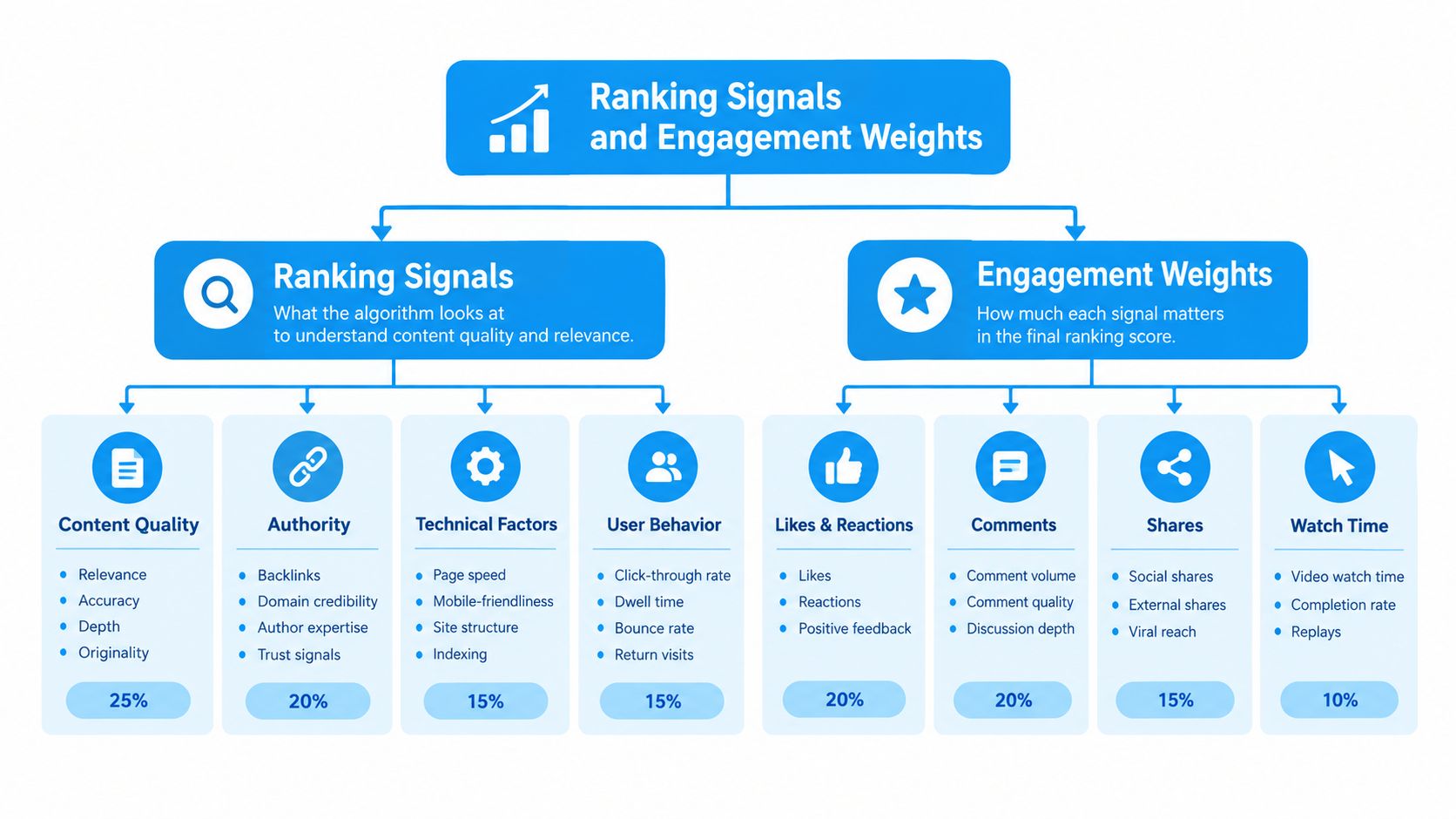
The visible like count is only one input. X evaluates several possible responses, much like a shopkeeper judging interest through browsing, questions, purchases, and customers who return. A like signals approval, while a reply shows effort, a profile visit suggests curiosity about the author, and reading time indicates attention without requiring a button tap.
X's technical ranking documentation lists predicted probabilities for actions including likes, replies, reposts, quotes, follows, blocks, and shares, while dwell-related behavior is treated as a continuous target (technical ranking documentation).
What the system is trying to predict
The model can estimate reactions separately. One post may have a strong likelihood of earning likes but a weaker likelihood of generating replies or profile visits. Another may collect fewer likes while producing longer reading and a detailed discussion.
The system combines these predictions with different weights. Positive actions can support distribution, while muting, blocking, reporting, or marking content uninteresting can reduce it. The weighting can change over time, so a public diagram should guide analysis rather than serve as a permanent formula.
That distinction makes high-intent engagement strategically useful. A profile visit shows that someone wanted more context about the author. A reply begins a relationship-building exchange. Careful reading supplies attention that may remain invisible in the like total.
Design for behavior, not buttons
A founder might post, “We learned a lot from our launch.” Readers can approve that statement, but it gives them little to answer. A stronger post identifies the decision, explains the trade-off, and asks how others handled a similar situation.
The objective is to make a meaningful response natural:
- Use a specific claim that readers can evaluate.
- Add enough context to make the post understandable without guesswork.
- Invite a useful response through a question, contrast, or unresolved decision.
- Continue the discussion so replies form a real exchange instead of one-word reactions.
A post earns stronger signals when it gives people a reason to think, respond, and learn more about the author.
Total engagement and engagement rate answer different questions. The distinction is explained in engagement versus engagement rate, and it matters when comparing posts shown to different audience sizes.
A large like count can hide limited conversation or shallow attention. Group results by replies, reposts, profile visits, clicks, dwell behavior, and negative feedback. Then connect each signal to the content choice that may have produced it. This reveals whether a post is attracting passive approval, sustained attention, or actions that move a reader closer to the author.
Timeline Variants and Content Filtering Rules
The phrase “the X algorithm” hides an important distinction. X has different viewing surfaces, and the user's chosen surface changes the role of ranking.
For You is the clearest example of predictive recommendation. It can combine posts from followed accounts with content discovered through machine learning. A post may appear because the system predicts that the user will value it, even when the author isn't part of the user's direct network.
Following serves a different intent. Users who select it generally want posts from accounts they chose to follow, so the follower relationship becomes more central. Ranking and display behavior can still involve platform rules, but discovery from outside the user's network isn't the same objective as it is in For You.
Latest or a strictly chronological view prioritizes publication order. A post that performs well in predictive ranking may not appear at the top there because the timeline isn't trying to place the most relevant item first. It's trying to show the newest eligible item first.
That difference explains an apparent contradiction: a post can be highly visible in discovery while appearing less prominent to someone checking a chronological view. The post hasn't necessarily been suppressed. The two surfaces are answering different questions.
Final filters shape what survives
After retrieval and scoring, X can apply filtering and mixing rules before display. These rules can address duplication, spam, negative feedback, and other quality or safety concerns. A post that receives a block, mute, report, or “not interested” action gives the system a reason to reduce its future distribution for relevant audiences.
Creators should therefore separate audience intent from ranking performance. Use For You to reach people who haven't chosen to follow you yet. Use Following and Latest to serve an audience that wants direct updates from selected accounts.
That distinction also changes measurement. Don't judge every post by a single feed experience. Compare discovery outcomes, follower responses, conversation quality, and profile actions, then connect those results to the surface where users encountered the post.
Common Myths and Misconceptions Debunked
Many X growth guides preserve tactics from the chronological era. They recommend stuffing hashtags, publishing at a rigid minute, or chasing a fixed like target. Those suggestions treat the platform as a simple distribution schedule, but X ranks candidates through a predictive pipeline.
Myth one, hashtags determine reach
Hashtags can clarify a topic for readers, but they aren't a substitute for relevance or interaction. The verified architecture emphasizes user, post, and engagement signals rather than a single hashtag mechanism. A post with a perfectly chosen hashtag can still fail if users don't read, reply, visit the profile, or share it.
Use a hashtag when it helps a community identify the subject. Don't use a long string of tags as a replacement for a clear argument.
Myth two, posting time controls distribution
Recency remains a useful input, but X no longer operates as a purely reverse-chronological feed. The system ranks recent posts by predicted relevance and engagement, so publishing at a convenient audience moment can help, but timing can't rescue weak content.
A practical test is to publish when your audience is plausibly available, then study the actions that follow. If the post earns attention but no conversation, changing the time won't solve the underlying problem.
Myth three, likes are the whole game
Likes matter, but the system predicts several actions separately. Replies, reposts, quotes, follows, clicks, profile visits, and dwell behavior can reveal more about a user's intent than a passive reaction. Negative actions also matter because they can reduce predicted value.
Myth four, follower count guarantees reach
The pipeline narrows and scores candidates using interaction history, not raw follower graph size alone. A large audience doesn't make every post relevant to every follower. A smaller account with a precise topic and strong conversation can enter recommendation contexts where its content matches user interests.
Replace the question “How do I get more likes?” with “What useful action should this post make easier?”
Semantic relevance and reply-oriented formats deserve more attention than mechanical hashtag or clock-based tactics. The strongest optimization is usually editorial: choose a clear audience problem, make a specific point, and create a natural reason for the right readers to respond.
Actionable Strategies for Creators and Brands
Technical knowledge becomes useful when it changes what you publish. The pipeline suggests a simple operating principle: design each post for the next meaningful action, then measure whether readers took it.

Start with a narrow promise
A broad statement gives readers little to engage with. A narrow promise creates a clearer match between the post and the audience.
For example, instead of saying “Founders should use data,” write about one decision, one observed behavior, and one implication. A creator teaching design might share a before-and-after explanation of a landing page choice. A social media manager might compare two ways to turn customer questions into content.
Specificity helps retrieval because the post has a clearer subject. It also helps scoring because readers can more easily decide whether to continue reading, reply, or visit the author's profile.
Build the post around a response
Use a structure that gives readers a path into the conversation:
- Observation: State what happened or what you noticed.
- Reasoning: Explain why it matters.
- Tension: Identify the trade-off or disagreement.
- Prompt: Ask a question that requires more than approval.
Don't manufacture controversy. Ask for experience, alternatives, or a decision. Those prompts produce more useful replies than “Thoughts?” because they tell readers what kind of response will help.
Optimize for reading time honestly
Dwell behavior isn't a cue to make posts artificially long. It rewards relevance and clarity. Use a strong opening, short paragraphs, concrete examples, and enough substance to justify continued attention.
A founder could open with the decision that changed a launch, then explain the evidence and what they would do differently. A creator could turn a tutorial into a sequence of clear steps rather than a vague motivational statement. The reader should stay because the post keeps answering a valuable question.
Treat early replies as product feedback
When a post starts a discussion, participate. Answer questions with substance, clarify ambiguous points, and notice which parts create disagreement. Your replies can also reveal future topics, language, and objections that deserve their own posts.
XBurst is one option for operationalizing this workflow. Its opportunity feed scores tweets in your timeline, while its analytics track interactions such as replies, profile visits, impressions, likes, and related rates. Use those features to decide where to spend attention and to compare the behaviors produced by different content types, not to chase an abstract visibility score.
Review patterns, not isolated wins
Create a simple content log with the topic, format, opening, intended action, and observed responses. Look for recurring relationships:
- Posts that earn profile visits may communicate a strong point of view.
- Posts that earn replies may frame a useful question or disagreement.
- Posts with strong reading behavior may provide clearer structure or deeper explanation.
- Posts with negative feedback may miss the audience, overpromise, or create confusion.
This approach gives you a durable content system. You aren't trying to guess a secret trick. You're testing whether your ideas create the kinds of interactions the recommendation pipeline can recognize as valuable.
The Future of Algorithmic Transparency
X's recommendation system has moved from a closed black box toward partial public inspection. In April 2023, X open-sourced parts of its recommendation system on GitHub, exposing more of the Home Mixer process and its machine-learning approach, as reported in Buffer's history of the Twitter timeline algorithm.
The release didn't turn the system into a fixed public formula. It showed an architecture that can change, with retrieval, scoring, filtering, and mixing working together. In 2026, X open-sourced the algorithm again. Coverage of that repository described 187 files changed, 18,263 additions, and 926 deletions, evidence of substantial ongoing development rather than a finished specification, according to the same account of X's algorithm updates.
That distinction matters for anyone building an audience. Public code can reveal design patterns, but it can't promise that today's weights will remain tomorrow's weights. A creator who copies one visible rule may fall behind when the system changes, while a creator who understands the underlying objective can adapt.
The durable principles are straightforward:
- Relevance beats chronology.
- Conversation reveals more intent than passive approval alone.
- Profile visits, clicks, and reading behavior add context to visible engagement.
- Negative feedback can reduce distribution.
- The candidate pipeline matters before a post ever reaches final ranking.
- Measurement should connect content choices to specific user actions.
The best response to algorithmic change isn't constant panic. Build a clear subject area, publish useful ideas, invite genuine discussion, and review the behaviors your posts generate. That strategy remains valuable even when the models, labels, and ranking weights evolve.
XBurst helps creators, founders, and brands act on this pipeline by surfacing high-opportunity conversations, generating on-brand replies and posts, monitoring niche trends, and measuring replies, profile visits, impressions, likes, and rates. Visit XBurst to see how its opportunity feed and analytics can turn algorithm insights into a practical daily workflow.