
Social Media Engagement Strategy: The Growth Playbook
Build a data-driven social media engagement strategy that turns passive scrollers into an active community using proven discovery and automation tactics.
Most social media advice starts with a publishing calendar. That's backwards. A schedule can help you stay visible, but it won't create the relationships that turn attention into trust, referrals, and revenue. If your team posts, closes the tab, and waits for the algorithm to do the rest, you're treating a conversation platform like a billboard.
A stronger social media engagement strategy starts with replies. You find the discussions your audience already cares about, add a useful point of view, and follow up while the context is still fresh. Your own posts then support that work by giving new contacts somewhere credible to land. The result is less broadcasting into an empty feed and more deliberate relationship building.
Defining Your Audience and Brand Voice
Engagement usually fails before the first reply because the account has no clear point of view. “Entrepreneurs,” “marketers,” or “people interested in fitness” aren't audiences. They're broad labels that don't tell you what a person worries about, what they already believe, or what would make them stop scrolling and respond.
Start with the problem your community is actively trying to solve. A founder building in public may want sharper distribution without sounding like a salesperson. A creator may want feedback from peers who understand the craft, not generic praise from passive followers. A startup buyer may care about implementation risk more than product features. These people can share an industry while requiring completely different conversations.
Build an audience map
Write a short profile for each priority segment using four prompts:
- Current pressure: What decision, obstacle, or uncertainty occupies their attention?
- Existing language: Which phrases do they use when describing the problem?
- Desired identity: Who do they want to become, or how do they want others to see them?
- Conversation triggers: Which opinions, mistakes, launches, or trends reliably draw them into discussion?
Keep the map close when you write replies. A useful response to a solo founder may explain the trade-off behind a tactic. A useful response to a marketing manager may add a process, measurement method, or governance consideration. The subject can be similar, but the relevance changes with the person.
Your audience also exists inside a global network. DataReportal's Digital 2025 global overview estimated 5.24 billion social media user identities worldwide, equivalent to 63.9% of the global population, with the total increasing by 4.1% during the preceding twelve months. The same analysis reported that the typical internet user spent 2 hours and 21 minutes per day using social media. Those figures describe user identities rather than necessarily unique individuals, but they still show why a narrow, culturally aware voice matters in a crowded environment.
Turn your voice into operating rules
A brand voice charter should be short enough to use during a fast-moving thread. Define three tonal pillars, such as practical, candid, and encouraging. Then define what each pillar means in a reply.
“Candid” might mean naming the cost of a tactic instead of promising effortless growth. “Practical” might mean offering a concrete next step before mentioning a product. “Encouraging” might mean challenging an idea without belittling the person who shared it.
Add vocabulary constraints. List words you use often, phrases you avoid, and sentence patterns that sound like your team. Decide whether you use humor, how much jargon you tolerate, and when a serious topic requires a measured tone. For examples of how different personalities can become recognizable writing systems, review these brand voice examples.
Practical rule: If a reply could be posted by any competitor without changing a word, it isn't yet expressing your voice.
Finally, define the boundary between a public response and a private conversation. Public replies should teach, clarify, or create a useful opening for others. DMs should handle context that shouldn't be exposed publicly, such as account details, personal circumstances, or a specific buying decision. That distinction keeps your engagement helpful instead of intrusive.
Discovering High-Opportunity Conversations
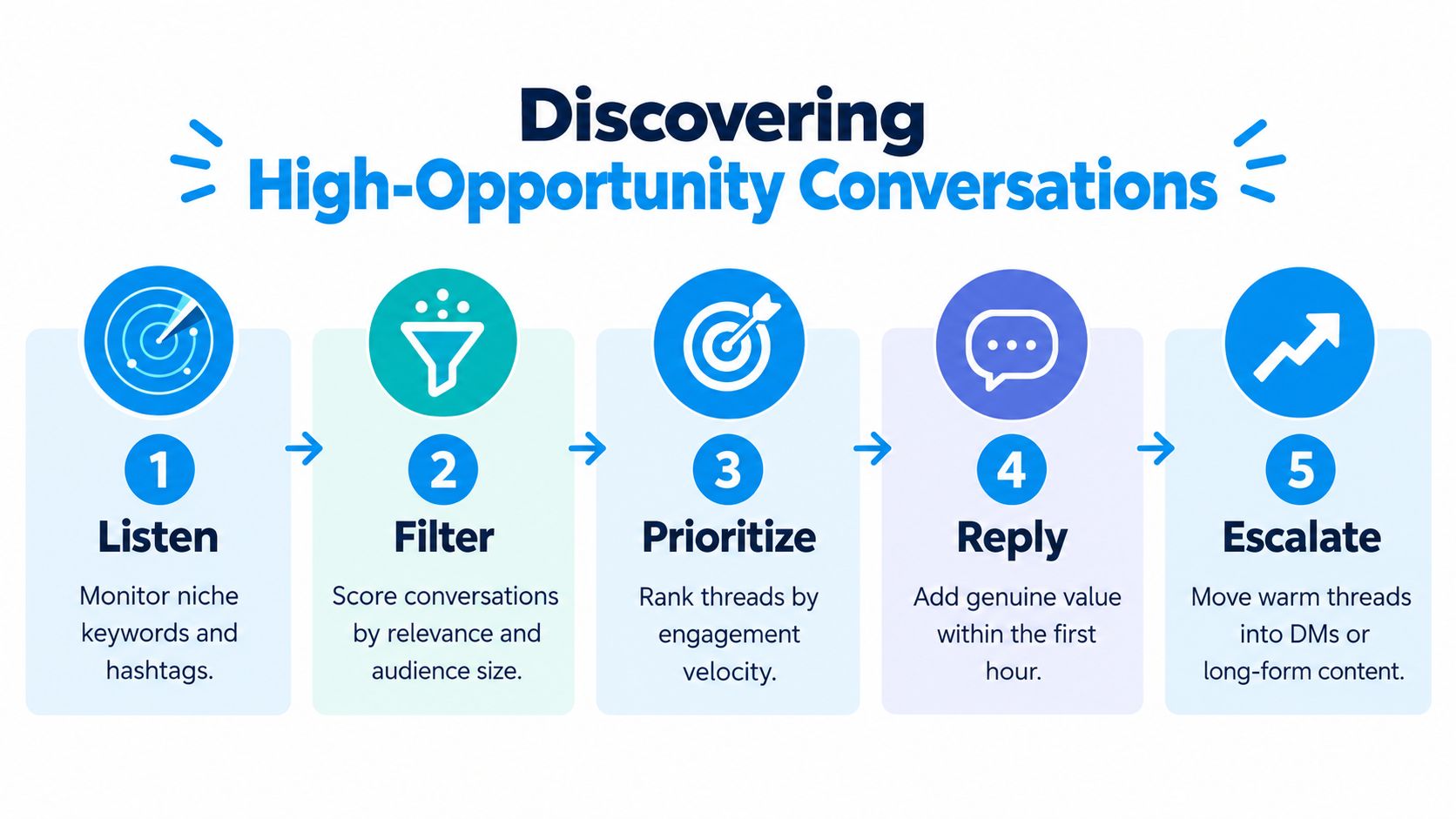
Passive scrolling gives you information, but it rarely gives you a repeatable growth process. A reply-first operation treats the timeline as a live research environment. You're looking for relevant threads, early signals, unanswered questions, and moments where your expertise can improve the conversation without hijacking it.
The best opportunity isn't always the post with the largest audience. A massive thread may already be saturated with identical reactions. A smaller discussion among the people you want to reach can produce stronger relationships if the author responds, other readers recognize the problem, and your contribution adds something distinct.
Listen before you filter
Create listening streams around four types of input:
- Problem language: Phrases people use when asking for help or describing frustration.
- Category language: Terms connected to your market, product class, or craft.
- Named accounts: Creators, operators, publications, and customers whose discussions attract your target audience.
- Emerging language: New expressions, events, product changes, or debates that your niche is beginning to repeat.
Don't rely only on hashtags. Search for the messy wording people use in real questions. A founder may not write “customer acquisition strategy,” but they may ask why their launch received attention without producing conversations. That question is often a better engagement opportunity than a polished industry keyword.
Niche trend monitoring on X becomes useful when it helps you recognize a discussion early, not when it encourages you to force your brand into every popular topic. Relevance comes before velocity. If you can't add informed context, leave the thread alone.
Score the thread, not just the post
Use a simple internal score based on qualitative criteria:
- Audience fit: Are the people reading or replying likely to matter to your goals?
- Conversation openness: Is the author asking a question, sharing a dilemma, or inviting disagreement?
- Distinct contribution: Can you provide an example, counterpoint, framework, or clarification?
- Timing: Is the discussion still developing, or has every useful angle already been covered?
- Relationship potential: Is there a reason to follow up with the author or an engaged participant later?
Engagement velocity matters because early replies can shape the direction of a thread, but speed doesn't excuse shallow commentary. “Great post” is fast and forgettable. A concise observation that explains why a tactic works, where it breaks, or what to test next gives people a reason to continue.
A useful reply should stand on its own for everyone who sees it later. Avoid turning someone else's post into an advertisement for your account. If your contribution earns a profile visit, the profile should reinforce the same point of view through clear positioning, useful pinned content, and evidence of ongoing participation.
Building Your Daily Engagement Playbook
A sustainable workflow removes the daily question, “What should I do first?” It also prevents the opposite failure, where a manager spends an entire day reacting to notifications without making deliberate choices.
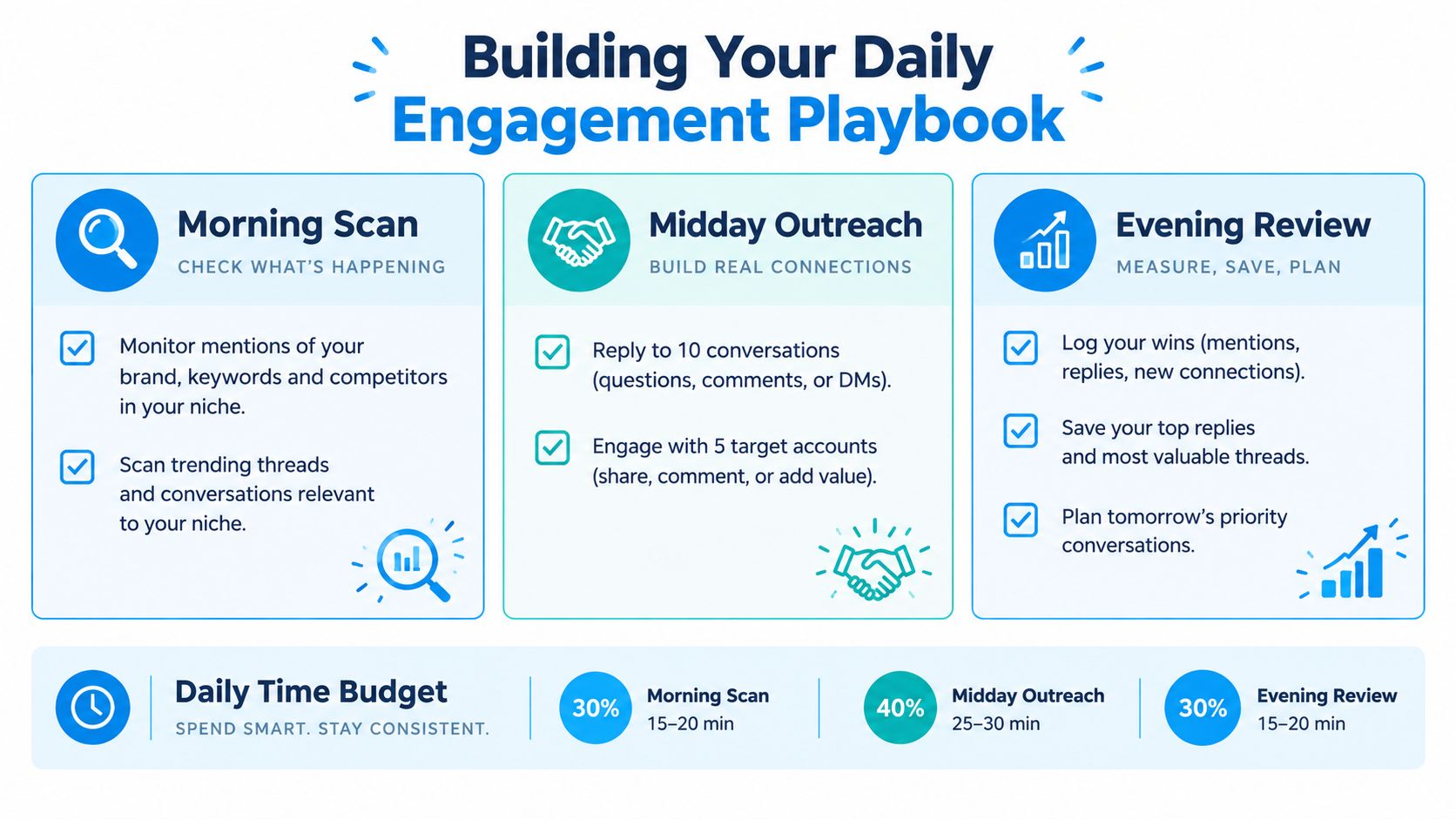
Use three engagement blocks. The exact timing can follow your audience's availability, but each block needs a separate job. The morning block discovers opportunities, the midday block creates interaction, and the evening block captures learning.
Morning scan
Start with mentions, replies to your own posts, saved target accounts, and conversations connected to your listening terms. Mark each opportunity as reply now, monitor, or ignore. This small decision prevents interesting threads from consuming attention just because they appeared first.
Next, select a short priority list. Choose discussions where your audience fit and contribution potential are both strong. Read the original post, several replies, and the author's recent context before writing. The extra reading helps you avoid repeating an answer that someone already gave or misreading an intentionally provocative statement.
Midday outreach
Write replies using a framework rather than a canned script. The framework should shape your thinking, not make every response sound identical.
Value-Add Pivot starts by acknowledging the specific point, adds a related insight, and pivots to a practical implication.
“The distinction between reach and qualified attention is important. I'd add one test: track whether the people who engage take a second action, such as visiting the profile or asking a more specific question. That separates curiosity from useful intent.”
Contrarian Follow-Up works when you disagree without performing disagreement. State the accepted assumption, explain where it fails, and offer a condition under which it becomes valid.
“Consistency helps, but consistency around weak ideas only creates a larger archive of weak ideas. I'd protect the cadence while changing the feedback loop, then keep the formats that attract thoughtful follow-up.”
For product questions, answer the question before mentioning what you sell. For criticism, clarify the facts and acknowledge the valid concern. For a toxic debate, set one boundary and exit:
“I'm happy to discuss the implementation decision, but I'm not going to continue a personal exchange. The relevant trade-off is documented above.”
A team that needs to coordinate these habits across accounts can adapt a scalable social team framework to assign ownership, escalation rules, and review responsibilities.
Evening review
Log the conversations that produced meaningful follow-up, not only the replies that attracted visible reactions. Save strong responses in a library organized by topic and intent. Note which openings led to profile visits, thoughtful replies, qualified DMs, or a second interaction from the same person.
The review should also identify what to stop doing. If a recurring topic generates attention but never attracts the audience you want, it may be useful for reach but inefficient for your engagement block. If a certain reply style creates debate without clarity, revise the style rather than increasing volume.
Automating Workflows Without Losing Authenticity
Automation is useful when it reduces operational friction. It becomes dangerous when it removes judgment from interactions where tone, consent, context, or cultural nuance matters.
The practical dividing line is simple: delegate preparation, retain responsibility. An assistant can collect conversations, summarize a long thread, suggest an opening, identify repeated questions, and organize accounts for follow-up. A person should decide whether the response is appropriate, whether it reflects the brand's actual position, and whether the final wording deserves to be public.
Use a risk-based delegation model
Low-risk assistance includes:
- Discovery: Finding posts that match defined topics, accounts, and audience signals.
- Prioritization: Sorting opportunities by relevance, conversation openness, and likely relationship value.
- Drafting: Producing several reply angles that a human can edit or reject.
- Analysis: Summarizing recurring objections, questions, and patterns in weekly performance.
- Administration: Organizing lists, tracking follow-ups, and preparing a publishing queue.
High-risk automation includes autonomous replies on sensitive subjects, conflict resolution, inferred-trait personalization, political or health-related commentary, and messages that imply personal experience the account doesn't have. These actions can damage trust even when the wording is grammatically perfect.
The issue isn't only whether AI can produce fluent text. Research on AI and social media personalization highlights continuing concerns about privacy, algorithmic bias, and user control over personal data in the relationship between personalization and engagement. You can read the relevant discussion in this academic research on AI and digital engagement.
Keep a human approval loop
A safe workflow has visible checkpoints:
- The system surfaces a conversation and records why it was selected.
- AI proposes a draft based on the thread and the approved voice charter.
- A human checks factual accuracy, tone, cultural fit, and whether the response adds value.
- The human edits or discards the draft.
- The team records sensitive decisions and reviews patterns for bias or repeated failure.
For an X-focused workflow, XBurst can analyze writing style, surface high-opportunity conversations, draft context-specific replies and posts, monitor selected creators, support smart scheduling, and provide engagement analytics. Use those capabilities to shorten research and preparation, not to manufacture a fictional personality.
Tools should also help you protect consent. Don't feed sensitive audience information into a system merely because it could make a reply more personal. Don't infer private traits from public behavior and present the inference as fact. If an interaction could affect a customer relationship, reputation, or safety, slow down and involve the person accountable for that outcome.
For practical guidance on constrained reply assistance, see how to automatically reply to tweets without losing context. The objective isn't maximum automation. It's faster, more consistent preparation with the final judgment still attached to a real operator.
Measuring Engagement Quality and Iterating
Follower growth and impressions answer distribution questions. They don't tell you whether the right people care, whether a conversation deepened, or whether attention moved toward a business outcome.
A useful measurement system separates visible interaction from intent. Likes and broad reach can indicate resonance, but replies, repeat participation, profile visits, qualified DMs, link actions, subscriptions, event participation, and CRM activity offer more context. The right signal depends on the stage of the relationship.
Create an engagement quality score
Don't pretend every signal has equal value. Build a simple score that reflects your funnel and keep the underlying events visible. For example, you might classify interactions as:
- Recognition: Likes, reactions, and brief acknowledgments.
- Participation: Substantive replies, quote posts, shares, and repeated discussion.
- Investigation: Profile visits, saves, link clicks, and questions about your process.
- Intent: Qualified DMs, subscriptions, lead actions, event participation, or a documented CRM progression.
- Relationship: A person returns to several conversations, refers someone, collaborates, or becomes a consistent community contributor.
This isn't a universal formula. It's a decision tool. A creator may value repeat participation more than a click. A B2B founder may treat a qualified DM as more important than a large number of low-context replies. Define the score with the people who own the business outcome.
| Metric Type | Examples | Business Impact |
|---|---|---|
| Vanity metrics | Follower count, impressions, likes, aggregate reach | Shows distribution or recognition, but provides limited evidence of relationship depth |
| Quality engagement signals | Reply depth, repeat participation, shares, saves, profile visits | Indicates that people found the idea useful enough to discuss, revisit, or investigate |
| Direct-intent signals | Qualified DMs, link actions, subscriptions, lead-generation actions | Connects social interaction to a potential next step |
| Relationship signals | Returning contributors, referrals, collaborations, CRM activity | Shows whether attention is compounding into durable community value |
Run a weekly conversation audit
Review your strongest and weakest conversations by topic, reply style, audience fit, and follow-up behavior. Ask four questions:
- Which discussions attracted the people you want?
- Which replies caused a second interaction rather than a one-time reaction?
- Which topics produced direct intent or useful customer language?
- Which activity consumed time without improving relationship quality?
Use Hootsuite's social trends research as background for the broader shift toward combining social metrics with direct-intent data. The operational lesson is more important than any benchmark: don't let an engagement dashboard reward activity that your sales, community, or retention teams wouldn't recognize as valuable.
DataReportal's global analysis also reported that people spent an average of 6 hours and 37 minutes per week watching short-form video content such as Reels, TikToks, and Shorts in 2025, approximately 57 minutes per day, while platform-level Android data showed average daily usage of 1 hour and 35 minutes on TikTok, 1 hour and 24 minutes on YouTube, and 1 hour and 10 minutes on Instagram in its comparison. Those figures support adapting ideas to each platform and format, but they don't make video automatically valuable. Measure whether the format attracts the right conversation.
Your 30-Day Execution Roadmap
A reply-first system needs a controlled launch. Trying to change your voice, monitoring, publishing, automation, and reporting all at once creates noise that makes it difficult to identify what improved.
Use the first week to establish identity, the second to build discovery, the third to create repetition, and the fourth to make decisions from evidence. The roadmap works for a solo founder, a creator, or a small social team because it separates strategic setup from daily execution.
Week one focuses on foundations
On the first day, define the audience problem you want to own and list the people or accounts already discussing it. On the next day, write your voice charter with tonal pillars, vocabulary preferences, and boundaries for sensitive subjects. Then audit the profile itself. The bio, pinned content, visual identity, and recent posts should make the intended community clear within a short visit.
Use the remaining days to create a reply library. Save examples of useful openings, respectful disagreements, product explanations, customer-support handoffs, and conversation exits. Don't copy the wording into every interaction. Study the structure and adapt it to the person and thread.
Week two builds discovery
Create listening streams for problem language, category terms, named accounts, and emerging topics. Review the results manually and remove noisy searches. A small, relevant stream is more useful than a large feed that trains you to skim.
Select priority accounts and record why each one matters. Note the subjects they discuss, the communities around them, and the types of questions that remain unanswered. End the week by choosing a daily discovery routine and a simple way to mark reply now, monitor, or ignore.
Week three makes the system repeatable
Run the morning scan, midday outreach, and evening review every working day. Start with a sustainable number of conversations that allows you to read context and edit carefully. Track the reply itself, the thread, the audience fit, and the follow-up outcome.
Publish your own content only when it supports the conversations you're already having. Turn a recurring question into a concise explanation. Expand a useful reply into a thread or short video. Invite people who contributed thoughtful context back into the discussion, rather than treating them as anonymous engagement.
Week four improves quality
Review the engagement quality score and compare topics, formats, and reply approaches. Remove activities that generate visible motion but weak audience fit. Keep the formats that create repeat participation, useful inbound questions, and clear next steps.
Audit your automation rules at the end of the month. Identify drafts that required heavy editing, categories that should never be automated, and summaries that missed important context. Update the voice charter and approval rules based on those failures.
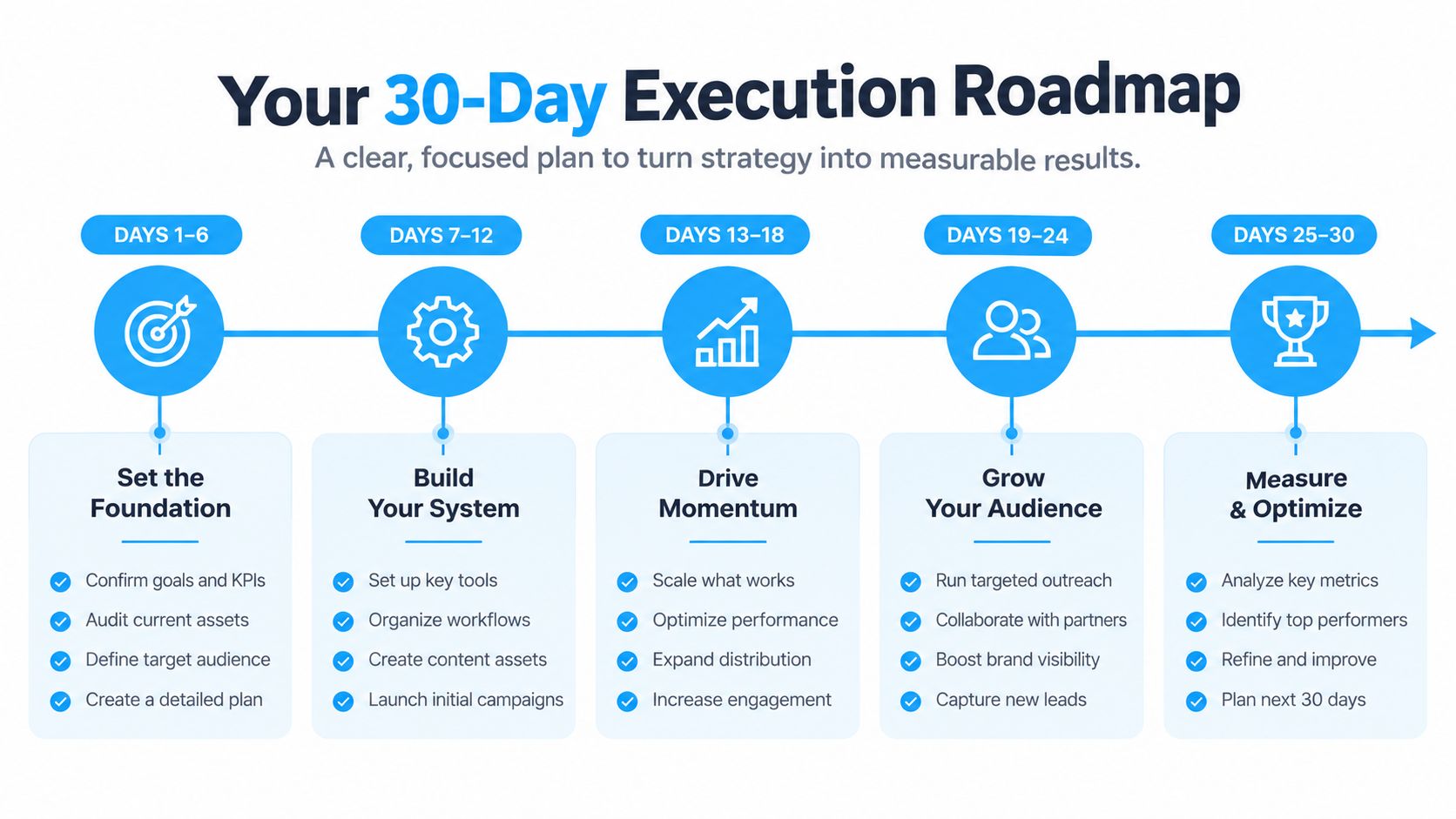
The compounding advantage comes from connecting every stage. A clear voice makes discovery more selective. Better discovery produces more relevant replies. Consistent replies reveal audience language. Quality measurement shows which relationships deserve further investment. Automation then supports the process without replacing the judgment that makes it work.
XBurst helps creators, founders, and brands discover high-opportunity conversations on X, draft on-brand replies, monitor selected accounts, schedule posts, and track engagement signals from a centralized workflow. Visit XBurst to explore the platform and start building a reply-first social media engagement strategy with a 3-day free trial.