
How to Make a Tweet Go Viral in 2026
Learn how to make a tweet go viral with proven hooks, timing, threads, and engagement tactics. Step-by-step guide with data, templates, and real examples.
On X, breakouts happen fast or not at all. In one empirical study of Twitter retweeting, 51% of first retweets happened within 1 minute, over 60% within 30 seconds, and about 90% arrived within 10 minutes (Springer study). That changes the whole framing of how to make a tweet go viral. This isn't mainly a copywriting exercise. It's an acceleration problem.
Most advice stops at the hook. Hooks matter, but they're only one part of the machine. A tweet breaks out when four things line up at once: the opener earns the stop, the format reduces friction, the timing catches people while they're active, and the reply chain starts moving before the post cools off.
That last part gets ignored far too often. Plenty of tweets die with a decent idea because the author treated publish as the finish line. On X, publish is the starting gun.
Why Most Tweets Never Break Out
Only a minority of tweets get any redistribution at all. As noted earlier, a large share never receives even a first retweet. That matters because a tweet that gets no early reaction rarely gets a second chance in the feed.
The common mistake is treating breakout performance like a pure writing problem. In practice, I see more tweets stall because the launch was weak than because the idea was bad. A solid post can die if it reaches inactive followers, gets no seeded attention, or sits with an empty reply thread for the first few minutes.
Where tweets stall
Three bottlenecks show up again and again:
- The post earns impressions but not interaction. People see it, keep scrolling, and the system reads that as low interest.
- The audience is mismatched to the moment. Good posts sent into a quiet hour often underperform weaker posts published when the right readers are online and ready to react.
- The reply chain never forms. Likes help a little. Replies, follow-on comments, and fast back-and-forth do much more to signal that the post deserves wider distribution.
That third point gets ignored in a lot of viral-tweet advice. Guides spend pages on the opener, then treat everything after publish like luck. On X, the first 10 minutes work as a coordinated system: the hook gets the stop, timing gets the right eyes, seeding gets the first participants, and reply velocity keeps the post alive long enough to travel.
Follower count is also a noisy metric here. I would rather launch a tweet into 2,000 active followers who reply than 20,000 passive followers who scroll past it. Reach starts compounding when people do something visible with the post, especially in the opening window.
If your posts consistently get seen but fail to pick up momentum, this breakdown of why Twitter engagement stays low covers the usual failure modes in more detail.
Practical rule: Judge a tweet by its first reactions, not by how polished it felt in drafts.
Virality is a launch system
The useful framing is operational. Breakout tweets usually come from coordinated execution, not isolated copy tweaks.
That system has four parts:
- Hook: clear enough to stop the scroll
- Timing: posted while your audience is active
- Seeding: early exposure to people likely to engage
- Reply velocity: fast responses that create visible activity under the post
Tools can help without replacing judgment. XBurst is useful as an early-engagement engine because it supports the part many creators neglect: getting the first layer of interaction moving while the tweet is still fresh. That is often the difference between a post that fades at 800 impressions and one that earns another round of distribution.
If you want extra tactical ideas beyond this guide, SuperX has a useful roundup on how to boost your X engagement today. The useful takeaway is simple. Early reactions stack. Late hope does not.
Writing the Hook That Stops the Scroll
A hook doesn't need to be clever. It needs to buy the next two seconds.
The strongest hooks usually combine four elements: a pattern interrupt, a specific promise, stakes or tension, and a payoff signal. If one of those is missing, the tweet can still work. If all four are missing, it usually won't.
The four-part hook formula
Pattern interrupt breaks the reader's autopilot.
Example before: “Some thoughts on startup marketing.”
Example after: “Most startup marketing advice is wasteful.”
The second version creates friction immediately. It challenges something the reader already sees all day.
Specific promise tells people what they'll get.
Weak: “A few lessons from posting on X”
Stronger: “3 posting changes that improved early engagement”
Specificity beats abstraction because readers can judge the value quickly.
Stakes or tension give the post energy.
Weak: “Threads can help growth.”
Stronger: “Threads help. But they also hide weak ideas.”
That line creates a conflict. It makes people want the explanation.
Payoff signal tells the reader the post resolves somewhere useful.
Weak: “A thought on replies”
Stronger: “Replies matter more than most creators think”
Before and after examples
Here's how weak openers usually fail:
- Too broad: “Marketing is changing fast”
- Too soft: “Maybe this is just me, but…”
- Too delayed: “I've been reflecting on some experiments recently…”
Here's what works better:
- Controversy: “Likes don't build reach. Conversations do.”
- Curiosity: “The tweet wasn't the growth lever. The replies were.”
- Confession: “I spent months optimizing hooks and ignored the multiplier.”
The hook's job isn't to explain everything. It's to make scrolling feel like a mistake.
A checklist you can paste into drafts
Before posting, run the opener through this quick filter:
- Concrete outcome: Does the first line name a result, conflict, or curiosity gap?
- Front-loaded specificity: Is there a number, name, or vivid word near the beginning?
- Immediate tension: Would a stranger have a reason to care within one glance?
- Clean payoff: Does the reader know why they should keep going?
A useful compression target is under 12 words for the opening thought. Not because every tweet must be short, but because concise openers force clarity.
Three hook templates work well across niches:
- Controversy template: “Many get [topic] wrong because they optimize for [wrong thing].”
- Curiosity template: “I changed one thing about [topic]. The result surprised me.”
- Confession template: “I kept doing [common tactic]. It wasn't the thing that moved the needle.”
If you're learning how to make a tweet go viral, spend less time sounding polished and more time making the first line impossible to ignore.
Choosing the Right Format and Length
Format decides how much friction the idea carries before anyone reads the second line. I've seen strong hooks stall because the format asked for too much work too early, and average ideas travel because the packaging made them easy to consume, easy to quote, and easy to reply to in the first 10 minutes.
The practical trade-off is simple. More space can make a tweet clearer. Less space can make it sharper. Both can win.
Earlier research in this article already covered how character constraints affect performance, so the useful question here is operational: what format gives this specific idea the best chance to get quick replies, reposts, and screenshots? Viral tweets rarely succeed on writing quality alone. They spread when the format supports the launch pattern around them.
Format choices that help or hurt velocity
Images usually help when they add proof. Screenshots of results, charts, product receipts, and before-and-after examples give people a reason to stop and a concrete asset to react to. Random stock visuals do the opposite. They take up space without adding a claim.
Links usually lower reach. That matches what operators see every week on X. Asking people to leave the feed is a bigger ask than asking them to like, reply, or repost. If the goal is traffic, that trade-off can be worth it. If the goal is breakout distribution, keep the main post native and move the link to a reply if needed.
Threads can work well, but only when each post earns the swipe. Metricool's analysis of X post formats found that threads generate stronger engagement than single posts, especially when the topic benefits from step-by-step delivery (Metricool on X study and trends). I use a blunt rule here. If post two does not increase curiosity, proof, or tension, the idea should stay a single tweet.
Tweet Format vs Performance
| Format | Avg Engagement Rate | Best Use Case |
|---|---|---|
| Single text tweet | Qualitatively strong when the idea is sharp and shareable | Opinions, observations, concise claims |
| Text plus image | Higher than text-only in prior research discussed earlier | Visual proof, screenshots, charts, memes |
| Single tweet with external link | Usually weaker reach than link-free posts | Traffic goals when reach is secondary |
| Thread | Stronger engagement in third-party format studies | Tutorials, breakdowns, multi-step arguments |
A practical decision rule
Use a single tweet when the core idea fits in one screen and one reaction. That format is best for claims people can quote, challenge, or endorse fast.
Add an image when it proves the point in under a second. The strongest images reduce skepticism. They also give early repliers something specific to reference, which helps the reply chain start with substance instead of generic praise.
Use a thread when the tweet needs setup, evidence, and payoff. In practice, that usually means three to five posts, not twelve. Long threads can still work, but they need stronger seeding and faster reply coverage because drop-off starts immediately.
Avoid putting the outbound link in the primary tweet unless clicks are the only goal. For viral reach, the better system is native post first, replies right after, and coordinated early engagement to keep momentum building. That is also where tools like XBurst fit. Not as a writing tool, but as part of the launch system that helps the right format get enough early interaction to matter.
Timing Your Tweet for Maximum Velocity
A strong tweet can win or lose before most creators finish their coffee. In practice, the first 10 minutes do more to shape distribution than the next 10 hours.
Timing is not just about picking 9:12 a.m. instead of 2:40 p.m. It is about coordinating four things at once: a hook that earns the stop, a posting window when your audience is around, a small amount of early seeding, and enough reply activity to show the post is alive. Guides that focus only on the publish time miss the part that usually decides whether a tweet stalls at 800 impressions or pushes past 20,000.
If you want a starting point for the time-of-day piece, use your own audience data first. This guide on best times to post on Twitter is a useful baseline before you set a repeatable schedule.
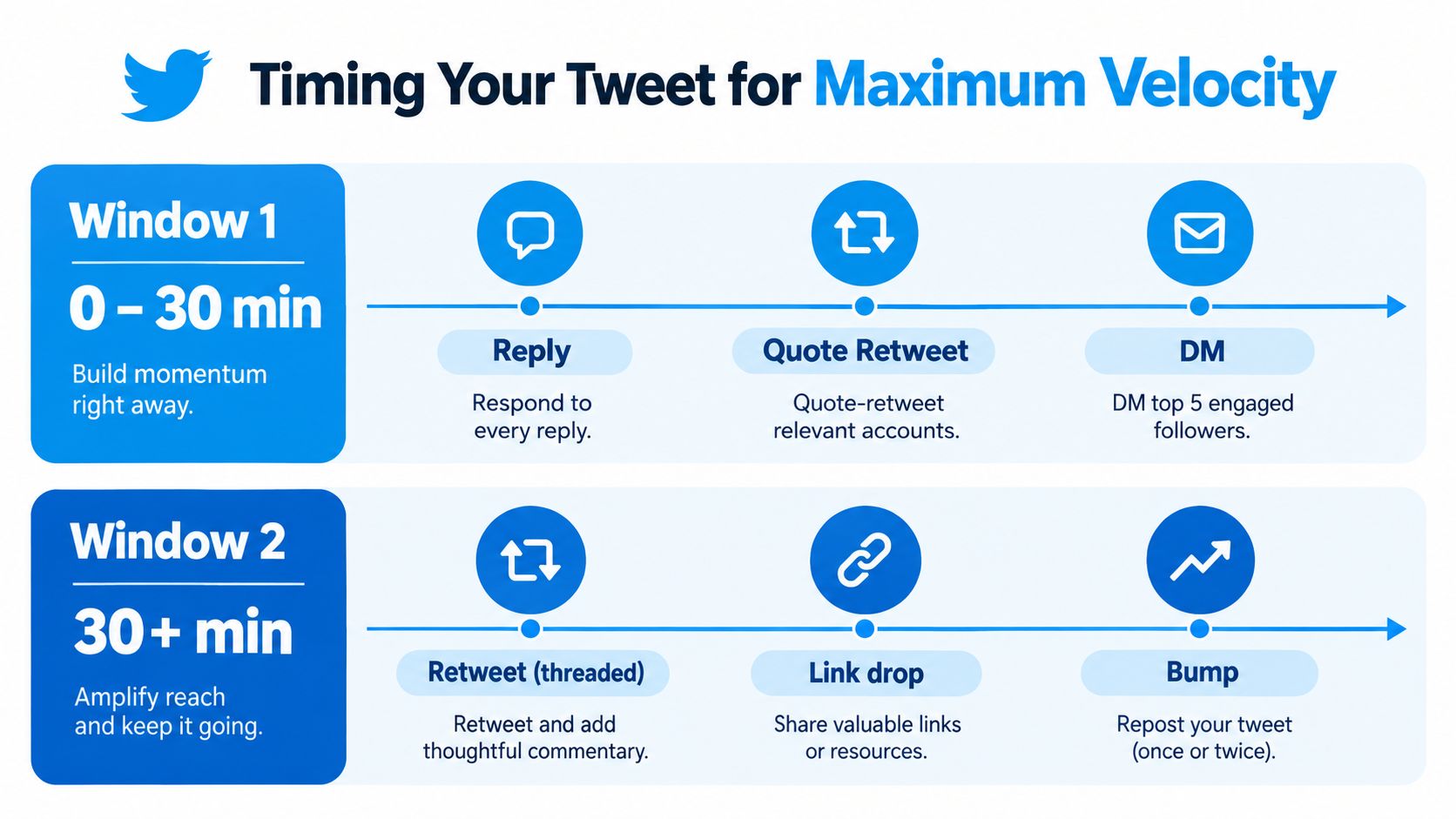
Window one: publish to 30 minutes
This window sets the slope.
A tweet with a sharp hook but no early interaction often dies. A slightly less polished tweet with fast replies can keep climbing because X has a clearer signal that people want to engage with it. I have seen that trade-off beat “perfect copy” more than once.
Use the first half hour like an operator:
- Reply within minutes: Stay at your keyboard. If the first 3 to 5 real replies come in, answer them fast and give people something to respond to.
- Seed a small circle: Message a few people who already engage with your posts and are interested in the topic. Three relevant replies beat thirty passive likes.
- Add your own follow-up if needed: If the tweet needs one clarifying detail, post it early so the thread has substance.
- Use XBurst as the engagement layer: XBurst helps coordinate those early interactions so timing, seeding, and reply coverage happen together instead of randomly.
The goal is short lag time between publish and conversation. Dead air is expensive.
Window two: 30 minutes to 4 hours
At this point, stop guessing and read the board.
If impressions are rising but replies are thin, the hook worked but the conversation did not. If replies are coming in and people are arguing, adding examples, or tagging others, keep working the post. That is the pattern worth supporting.
A few practical moves help here:
- Keep answering good replies: Prioritize comments that add an angle, question, or objection.
- Post one useful follow-up: Add proof, context, or a sharper takeaway in the thread.
- Extend the idea without repeating it: A quote post, screenshot, or second-angle post can carry momentum if the original is still moving.
I treat this as an active monitoring block, not a scheduled post and disappear block. The same habit matters on adjacent platforms. If you also publish on Threads, this guide on how to schedule Threads posts effectively is useful because the discipline is the same. Schedule the post, then schedule the follow-through.
Kill-switch rules
Some tweets are fine products and bad launches. Others are just weak tweets.
If a post gets little response after a fair test, stop pushing it. Do not keep poking the timeline with forced quote posts or needy replies. Save the underlying idea, change the framing, and try again in a better window.
The accounts that break out consistently are not the ones that rescue every post. They are the ones that spot weak velocity early, cut losses, and put their effort into tweets that already show signs of life.
Engineering the Reply Chain
Most viral-tweet advice underweights the one signal that can change the entire trajectory of a post: conversation.
Independent coverage of X's ranking signals says a back-and-forth reply between the author and another user is weighted at +75, versus +0.5 for a like (Postory analysis of ranking signals). Even if you treat leaked ranking numbers carefully, the practical message is clear. Likes are lightweight. Replies are distribution fuel.
Reply Chain Weight vs Likes in X Algorithm
| Engagement Type | Relative Weight | Action Trigger |
|---|---|---|
| Back-and-forth reply | +75 | Prioritize immediate response and keep the exchange going |
| Like | +0.5 | Treat as weak validation, not a growth lever |
If you want ideas for how to write replies that feel natural instead of robotic, this guide on how to reply to a tweet is useful. The best replies don't just agree. They add a detail, angle, objection, or follow-up question.
Design the chain before you publish
The cleanest way to think about this is to pre-build three reply roles.
First, write your own follow-up reply in advance. You add context you deliberately left out of the main tweet. It keeps the original post short while giving early responders more to work with.
Second, prepare an easy-answer question. Not a huge philosophical prompt. A low-friction one. Something people can respond to in one sentence.
Third, include a defensible edge in the original tweet. Not fake outrage. A point strong enough that people can agree, disagree, or refine it.
What actually works in replies
- Clarifying replies work when the original tweet is concise and provocative.
- Contrast replies work when you want to sharpen the point through examples.
- Question replies work when you want more people to join without feeling intimidated.
- Objection handling works when you know the likely pushback and address it early.
Don't write a tweet and hope people discuss it. Write a tweet that gives people a reason to enter the thread.
The most common mistake is ending the process at publish. The second most common mistake is replying with bland gratitude. “Thanks!” is polite, but it doesn't extend the conversation. A useful reply does.
If you're serious about how to make a tweet go viral, think of the original post as the spark and the reply chain as the oxygen.
Using XBurst to Systematize the Workflow
You can run this whole process manually. Many people do. The limitation is consistency. Manual workflows break the moment your schedule gets busy, and that's usually when timing and reply speed matter most.
That's where tooling helps. Not by replacing judgment, but by making the high-value steps easier to repeat. XBurst is one option in that category. It analyzes your writing style to help generate on-brand posts and replies, scans your timeline for high-opportunity conversations, surfaces niche trends before they peak, and supports scheduling plus analytics from one dashboard.

Map the workflow to the tool
A practical setup looks like this:
- Draft the post using style analysis to tighten weak openings and generate alternate hook angles.
- Check trend relevance so the tweet connects to a live conversation instead of publishing into a dead slot.
- Scan audience activity and choose a posting window based on when your followers are online.
- Schedule follow-through, not just the main tweet. That includes a clarifying reply and any planned follow-up variation.
- Review analytics after posting so you can see which topics, hooks, and reply structures led to stronger engagement.
What this changes operationally
The biggest benefit isn't convenience. It's repeatability.
Without a system, creators usually do one of two things. They either overwork the draft and ignore distribution, or they post often without learning from the outcomes. A workflow platform helps close that gap because the writing, timing, engagement, and review steps live in one place.
There's a caution here too. Systems can become rigid. If every post follows the exact same pattern, the content starts to feel templated. This piece on workflow standardization pitfalls is a good reminder that process should support judgment, not replace it.
The right way to automate
Use automation for:
- Scheduling recurring actions
- Surface-level trend monitoring
- Draft variation
- Performance review
Keep human control over:
- What's worth saying
- How sharp the opinion should be
- Which replies deserve real conversation
- When a tweet should be left alone
Good systems don't manufacture virality. They make it easier to execute the same disciplined launch behavior every time you publish.
Your Viral Tweet Launch Checklist
A common approach treats viral tweets as isolated events. That mindset makes improvement slow. A better approach is to treat each post as the output of a weekly operating rhythm.
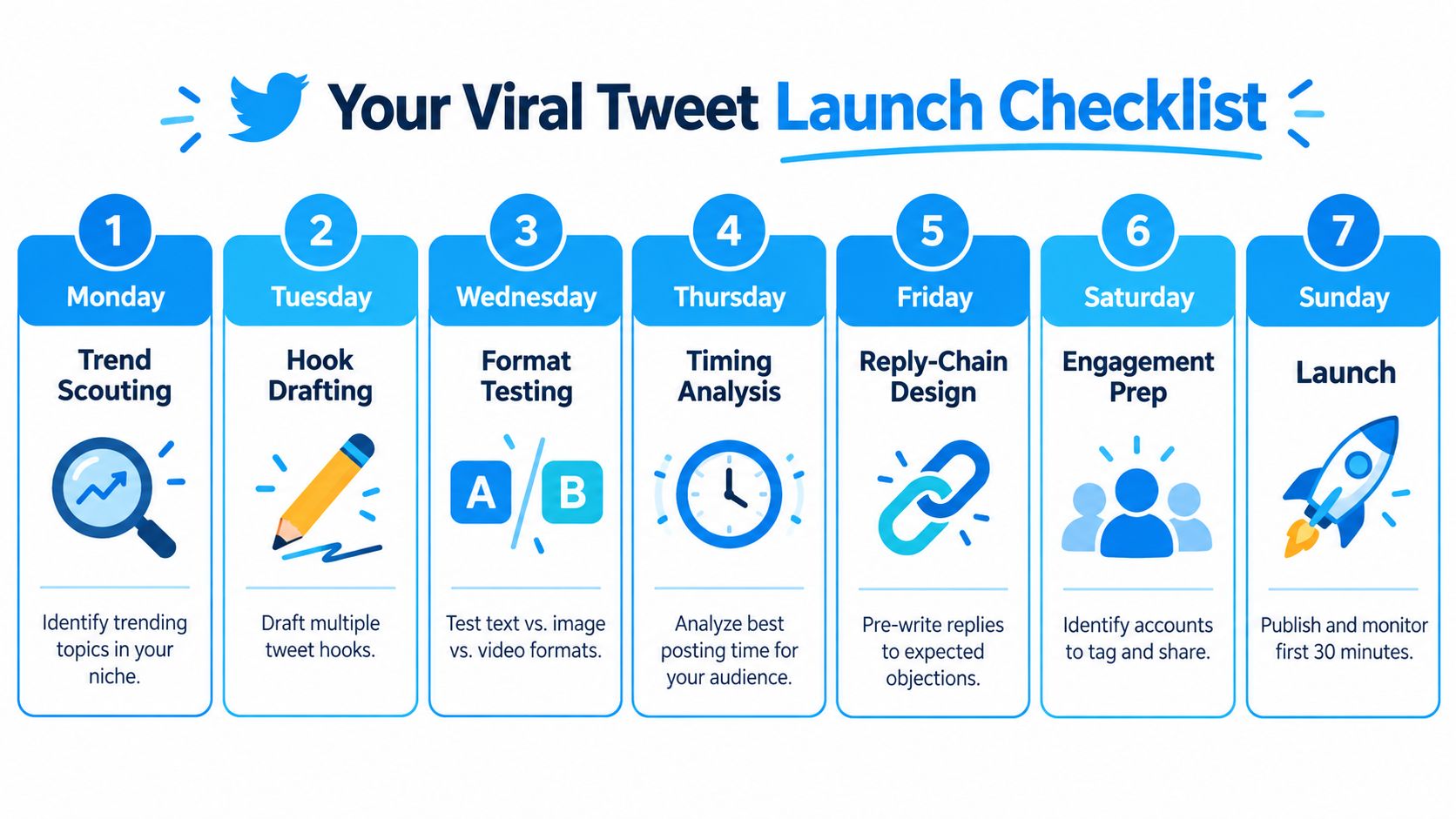
Monday through Wednesday
- Monday, scout the timeline: Look for recurring debates, questions, and fresh angles in your niche. Save topics that already generate natural disagreement or curiosity.
- Tuesday, draft hooks: Write multiple openings for the same idea. Push one version toward curiosity, one toward tension, and one toward blunt clarity.
- Wednesday, choose format: Decide whether the idea belongs in one tweet, one tweet with an image, or a thread. If the post needs a link, be honest that you're likely trading some reach for traffic.
Thursday and Friday
- Thursday, choose your posting window: Pick a time when your audience is active and you can stay present after posting.
- Friday, design the reply chain: Pre-write a clarifying reply, a follow-up question, and one response to the objection you expect first.
At this point, the tweet should already feel launch-ready. If it still reads like an internal memo, the hook is probably too soft.
Saturday and Sunday
- Saturday, prep engagement support: Identify people who regularly interact with your posts and are likely to engage if the idea resonates.
- Sunday, publish and manage the first window: Stay on-platform. Reply fast. Add context in-thread. Keep the discussion moving if people are leaning in.
A clean post-publish review looks like this:
- Did the opener stop people? You can usually tell by whether replies and reposts started quickly.
- Did the format help or hurt? Some ideas collapse under links or overlong phrasing.
- Did the replies deepen the reach? A lively thread usually tells you more than a pile of passive likes.
- Was the timing wrong, or was the idea weak? Those are different problems.
Virality isn't luck you wait for. It's acceleration you engineer through hooks, timing, formatting, and reply velocity.
If you keep reviewing tweets through that lens, you'll stop asking why random posts failed and start seeing the exact stage where momentum broke.
XBurst gives you a practical way to run that process without juggling separate tools for drafting, timing, engagement, and review. If you want help spotting high-opportunity conversations early, tightening hooks, and staying active during the window that matters most, visit XBurst.