
How to Scale Content Creation Without Burning Out
Learn how to scale content creation with proven workflows, automation, and templates built for creators and small teams, including a playbook for X.

You're posting three times a day on X, replying to threads for hours, and still watching growth flatten out. Every post starts with a blank page, every reply depends on your availability, and a missed day creates a backlog that feels impossible to recover. The problem usually isn't a lack of ideas or effort. It's that the entire operation depends on you manually pushing every asset from thought to publication.
Scaling content creation means designing a system that protects your time, voice, and judgment. You need reliable inputs, repeatable formats, defined review points, and a distribution loop that shows you what deserves more production. The following framework is built for solo creators, founders, and small teams that want more output without turning their social presence into generic automation.
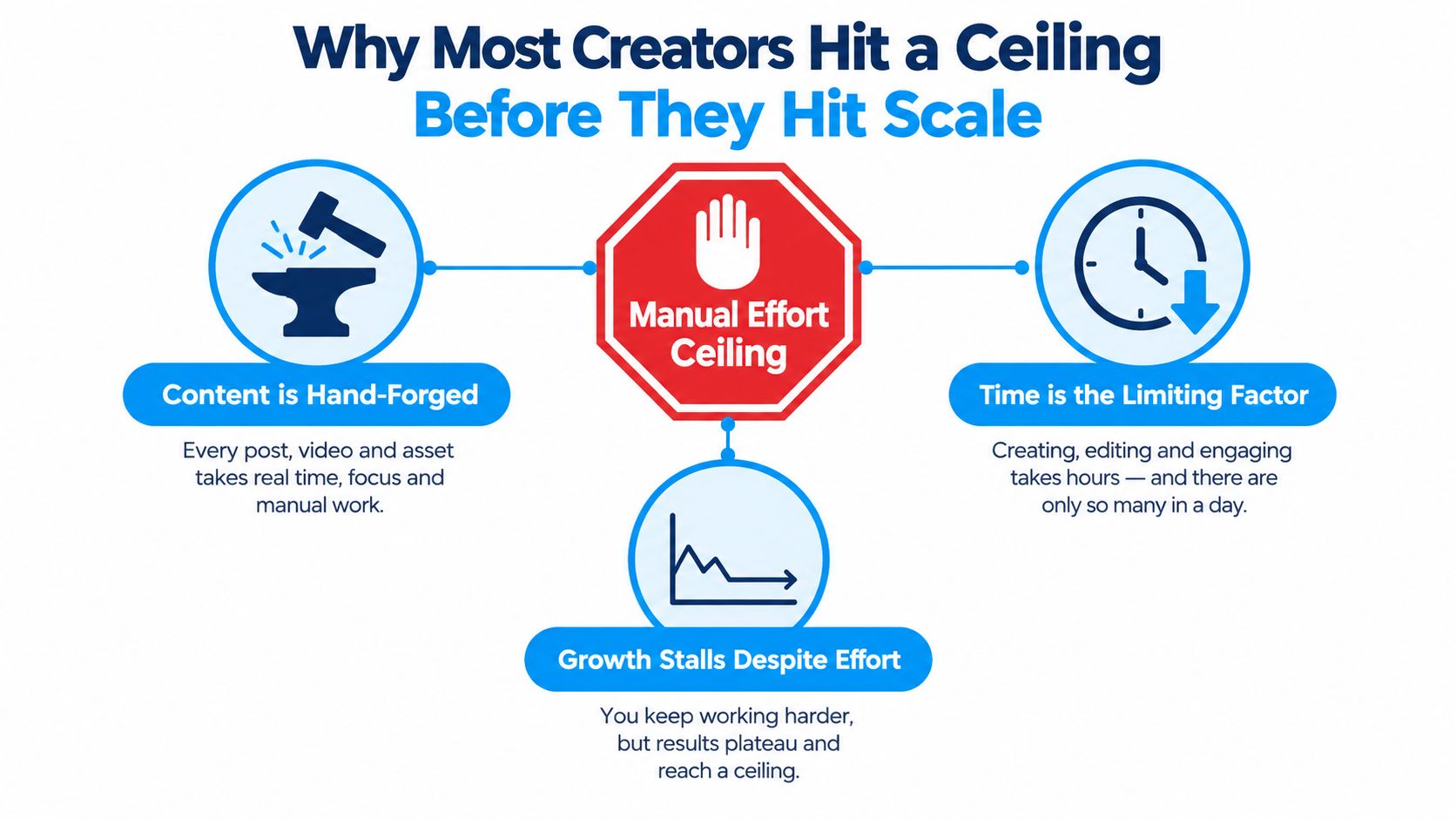
Why Most Creators Hit a Ceiling Before They Hit Scale
A solo creator can publish consistently for a while, then hit a hard limit. Research, outlining, drafting, editing, formatting, replies, and scheduling all draw from the same workday. More effort may lift output briefly, but it does not create additional capacity.
Consistency becomes the next constraint. If publishing depends on available time or creative energy, a strong week can be followed by silence and a rushed recovery. A 2026 content marketing benchmark reported that companies produce a mix of blog posts, social posts, and webinars at different cadences (Contentful's content marketing benchmark report). The lesson for a creator is practical: plan a deliberate portfolio of formats instead of asking one asset type to carry the entire account.
The three quiet constraints
Originality is the third constraint. Starting every post from a blank page consumes the attention needed for strong opinions, useful research, and timely observations. Quality can decline even when expertise remains high, because the creator's best thinking is spent on production mechanics.
Treat content as an operating pipeline. A research note can become an X thread, several short posts, a reply angle, a newsletter section, and a video outline. Templates capture repeatable decisions, while human review protects claims, judgment, and the recognizable voice behind the account.
Practical rule: Automate predictable work, not the point of view.
The fix is not another writing block. Define what enters the pipeline, which template it follows, who reviews it, and what qualifies it for publication. A solo creator can keep final control while removing repeated choices from drafting and formatting. A small team can then handle production without flattening the voice that made the content work in the first place.
Auditing Your Current Content Operation
Set aside 45 minutes and audit the operation you run, not the one you intended to build. Use seven questions, score each from 0 to 3, and record evidence beside every answer. A zero means the capability is absent, while a three means it's documented, repeatable, and visible in your workflow.
| Question | Score 0 | Score 1 | Score 2 | Score 3 |
|---|---|---|---|---|
| Do you maintain a predictable publishing cadence? | No planned cadence | Occasional bursts | Basic calendar | Calendar with planned capacity |
| Do you use more than one content format? | One format only | Experimenting rarely | Two recurring formats | Formats have defined roles |
| Do you repurpose core ideas? | Never | Sometimes, manually | Several derivatives | Repurposing is built into briefs |
| Do you track production time? | No measurement | Rough guesses | Time tracked inconsistently | Time tracked by format |
| Can another person follow your process? | No | Informal explanation | Partial documentation | Complete handoff documentation |
| Is your voice defined in usable guidance? | No style reference | Examples only | Basic voice notes | Style guide with examples and exclusions |
| Do you have consistent review checkpoints? | No review | Last-minute review | One quality check | Defined claim, voice, and approval checks |
Add the scores. A result from 0–7 indicates manual mode, 8–14 indicates assisted mode, and 15–21 indicates promptless readiness. These bands aren't a judgment of creative ability. They show where your next operational improvement is most likely to come from.
For example, an X creator shipping five original threads a week with no repurposing might score 8 out of 21. That creator has meaningful output, but the score still places the operation in assisted territory because format diversity, reuse, and documentation are weak. The priority isn't publishing more threads. It's capturing the research and turning each thread into a repeatable source asset.
For a broader workflow perspective, the Veo3 AI scaling framework 2026 is useful when you're mapping production stages and deciding where automation belongs. You can also use XBurst's guide to measuring content performance to connect operational output with audience response.
Choosing High-Impact Formats That Multiply Output
The right format is the one your operation can produce consistently, adapt without losing meaning, and measure clearly. Reach matters, but an impressive format that consumes the week will not scale a solo X account.
A thread works well as a pillar format on X because it gives you space to develop an argument, explain a process, or document a lesson. It requires more thought than a short post, yet it can provide several hooks and supporting points for later derivatives. A carousel converts the same logic into a visual sequence, which suits ideas built around progression or comparison. Short video communicates tone and demonstration quickly, but recording, editing, captions, and asset management add more work for a small team.
Compare the production trade-offs
| Format | Avg Draft Time | Shelf Life | Repurpose Yield | Best For |
|---|---|---|---|---|
| X thread | Higher | Medium to long | High | Arguments, lessons, frameworks |
| Carousel | Medium to higher | Medium | High | Visual teaching and comparisons |
| Short video | Higher | Short to medium | Medium | Demonstrations, personality, reactions |
| Atomic X post | Low | Short to medium | Medium | Hooks, observations, distribution |
These labels are operating estimates, not universal benchmarks. Replace them with your own time log once you have enough entries to compare formats. Track drafting, editing, approvals, publishing, and derivative production separately. A format that looks fast at the writing stage may become slow after review and design.
A solo creator with ten hours a week should not support every format at once. Choose one pillar format and one atomic format. The pillar carries depth. The atomic format keeps the account active and provides a quick way to test hooks, opinions, and responses.
Choose the format with the strongest input-to-output ratio, then require each core piece to produce at least four useful derivatives.
A mixed format plan generally gives a content operation more ways to distribute one idea than a single expression does, as noted earlier. Use that principle to design a system, not to copy a publishing quota. Brand activity benchmarks, including the Socialinsider social media benchmark, can provide context for platform differences, but they do not set a required personal schedule. Your available hours, review capacity, and audience response should determine cadence.
For a B2B SaaS creator on X, threads can serve as the pillar and quote graphics as the atomic unit. One product lesson can become a structured thread, a sharp visual statement, several replies, and a short founder observation. The team can then document the transformations in a format matrix, so future contributors know what each source asset should produce. That combination increases output without requiring the creator to become a full-time video producer.
Building Repeatable Workflows From Manual to Promptless
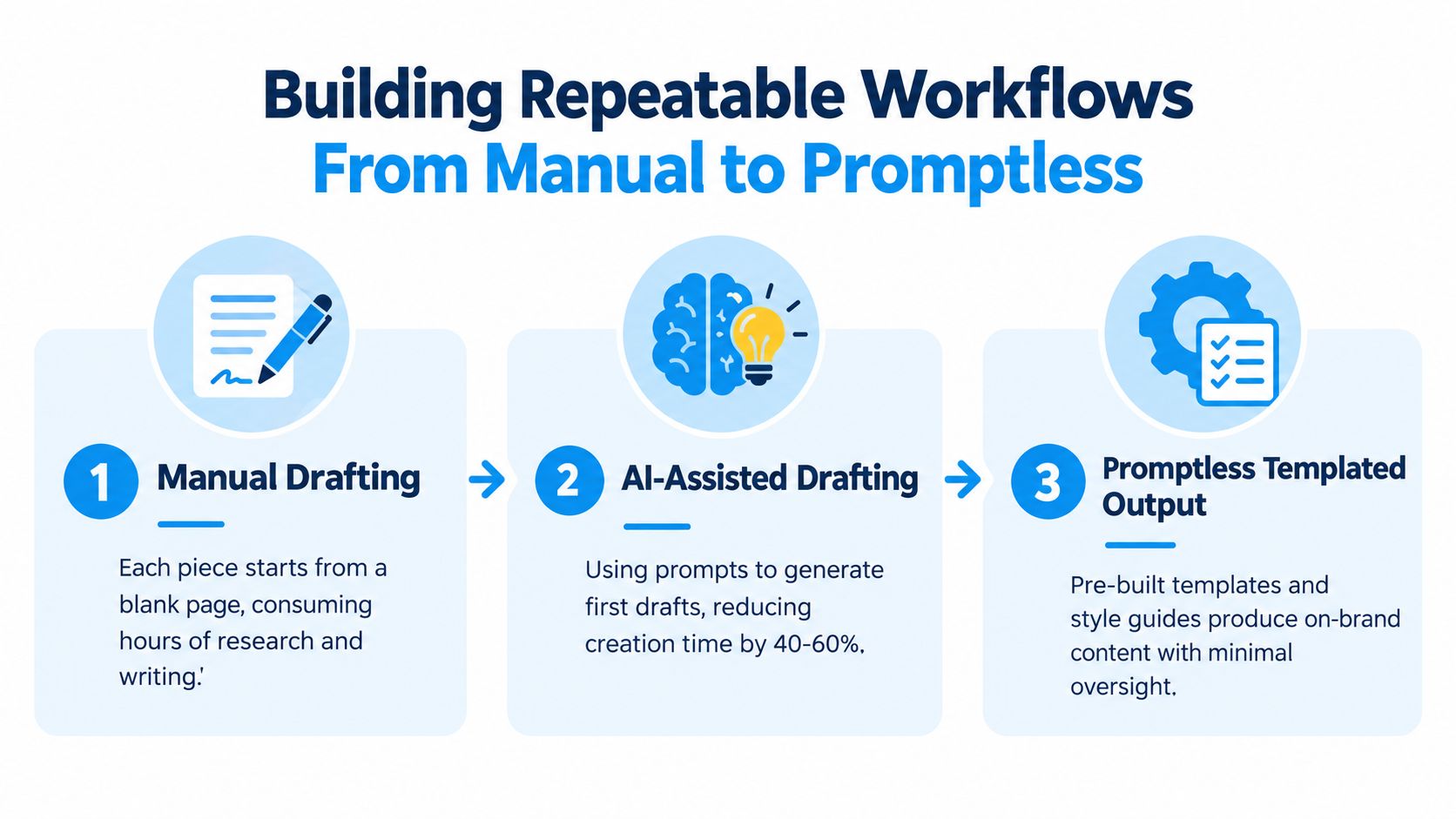
A useful progression has three stages: manual drafting, AI-assisted drafting, and promptless templated output. The stages aren't about removing humans. They're about moving human attention toward research, judgment, voice, and verification.
Stage one, manual drafting
Start with a brief containing the audience, claim, source material, desired action, format, and examples of the voice. The creator writes the first version and checks the reasoning, wording, and evidence. This stage is slow, but it reveals the decisions a template will eventually need to capture.
The failure mode is hidden process knowledge. If your editor asks why you chose a certain hook or structure, and the answer is “it just felt right,” another person can't reliably reproduce the result.
Stage two, AI-assisted drafting
Once you have solid briefs, use an AI writing tool to produce variations or a first draft. Keep the human checkpoints explicit: review voice, verify claims, remove unsupported specifics, and decide whether the argument deserves publication.
Neil Patel's benchmark reports 6 articles per month with manual workflows, 11 with AI-assisted workflows, and 19 with promptless SEO workflows, with the promptless figure representing more than three times manual output (Neil Patel's monthly content output benchmark). The operational point is that AI-assisted drafting helps, but repeated prompting remains a bottleneck if every request starts from scratch.
Stage three, promptless templated output
A promptless workflow stores the instructions inside reusable templates, topic clusters, examples, exclusions, and routing rules. A weekly X pipeline might look like this:
- Research capture: Save a source, observation, customer question, or product lesson.
- Brief assembly: Select the audience, angle, format, hook type, and CTA.
- Draft generation: Populate a thread, short post, or reply template.
- Human review: Check voice, factual claims, relevance, and originality.
- Distribution: Schedule approved content and record the publication date.
- Feedback capture: Add performance notes to the topic and format record.
A VA shouldn't receive “write something about onboarding.” They should receive a partially completed brief with the audience, approved idea, central claim, evidence, opening pattern, and examples of acceptable phrasing. That turns writing from an open-ended task into controlled assembly.
Tools that support this can include Notion or Airtable for the content database, Google Docs for review, a scheduler for approved posts, and AI drafting tools for variations. Resources on how to automate content planning and editing can help when you're deciding which handoffs belong in software.
Keep opinion pieces and breaking-news reactions out of rigid templates. Use a lightweight checklist instead, because those formats depend on timing, context, and a personal response.
Document approval ownership before you add another contributor. XBurst's content approval workflow guide is a useful reference for defining review states and reducing last-minute coordination.
Delegation, Hiring, and the Lean Team Model
Delegation only works when ownership is clear. Hiring a writer into an undocumented process doesn't remove work. It transfers confusion to another person, who then sends questions back to the creator.
| Model | Monthly Cost (USD) | Owns Drafting | Owns Editing | Owns Distribution | Break-Even Threshold |
|---|---|---|---|---|---|
| Fully solo | Not specified | Creator | Creator | Creator | When time remains available |
| Solo plus VA | Not specified | Creator or shared | Creator or editor | VA after approval | When admin work blocks high-value work |
| Small team of two to three | Not specified | Writer or creator | Editor | Dedicated owner | When consistent demand supports role specialization |
The brief doesn't provide verified cost ranges or revenue thresholds, so the table intentionally avoids invented financial figures. Use your own contribution margin and time value to calculate the point where delegation makes sense.
A solo operation keeps strategy, voice, drafting, editing, and publishing close together. That's efficient while the creator is still discovering the audience and refining the message. The downside is fragility. A busy launch, client deadline, or personal interruption can stop the entire publishing system.
A VA is often the first practical addition because distribution administration is easier to document than creative judgment. The VA can organize research, format drafts, load approved posts, update the calendar, and collect performance notes. The creator retains topic selection, claims, voice, and final approval.
A two- or three-person team can divide research, drafting, editing, design, and distribution. It offers more capacity, but it also creates more handoffs. The process must specify who owns the source brief, who can change the angle, who verifies claims, and who has final publication authority.
A hiring decision checklist
Hire only after you can answer these questions:
- Bottleneck: Which repeated task consumes the time you need for strategy or relationships?
- Ownership: What will the new person own from intake through completion?
- Evidence: Can you show three approved examples and one rejected example?
- Review: What must a human check before publication?
- Measurement: Which operational metric will tell you the hire is helping?
- Exit condition: What work will stop landing on your desk?
The common mistake is hiring an editor before defining the editorial standard. A creator can spend weeks explaining preferences that should have been captured in a style guide, examples library, and approval checklist. Document the workflow first, then delegate the part with the clearest boundary.
Repurposing at Scale With an X-First Example
Start with one substantial X thread built around a single argument. Don't ask every derivative to repeat the thread. Ask each format to preserve the core insight while changing the entry point, density, and action.
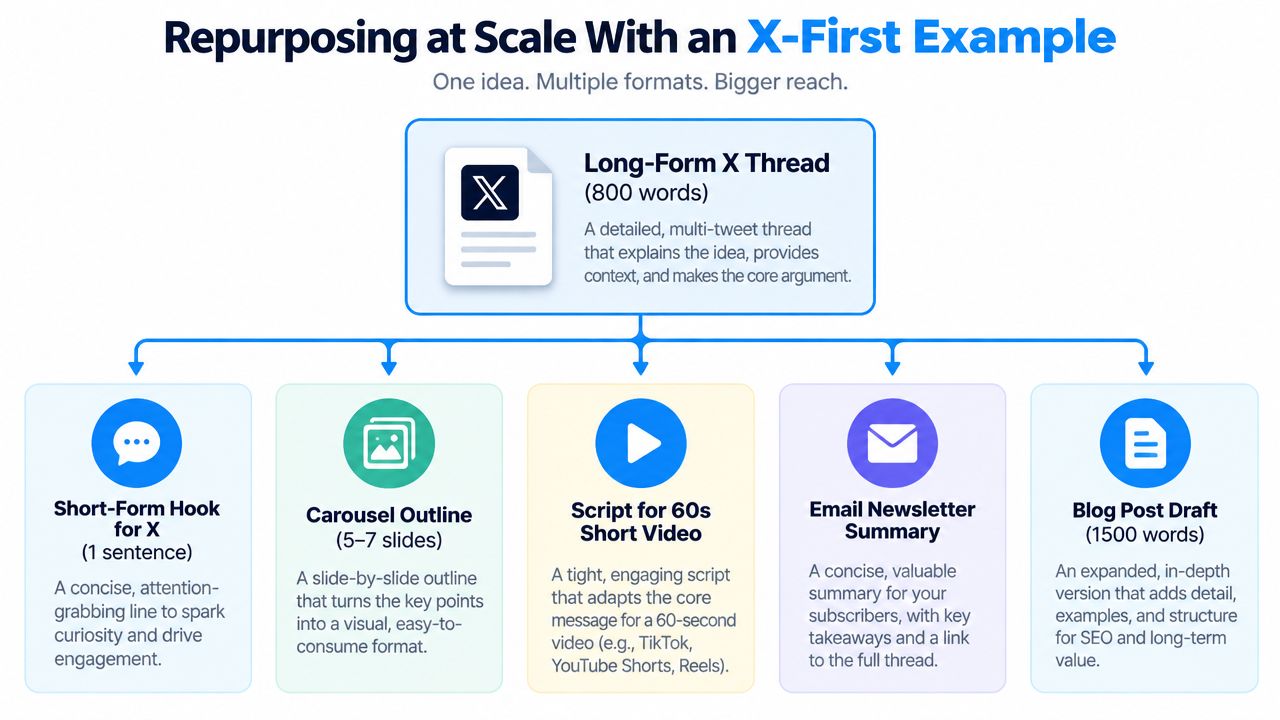
Suppose the thread explains why early-stage teams should document content approvals before adding more writers. The original X version can use a contrarian opening and a sequence of practical examples. From that source, build a week of related assets:
- Short X hook: Keep the sharpest tension in one sentence. Remove the explanation and invite a reply.
- Carousel outline: Turn the process into a slide-by-slide sequence. Each slide should carry one decision, not a paragraph copied from the thread.
- LinkedIn narrative: Add context about the team problem and explain the operational consequence. LinkedIn readers may need a fuller setup before the lesson.
- Email section: Write for an audience that already knows your voice. Summarize the insight, then link to the deeper argument or ask a direct question.
- Short video script: Use a spoken hook, one example, and one takeaway. Cut qualifiers that work on the page but sound slow aloud.
The repurposing matrix
| Source element | X post | Carousel | Video | ||
|---|---|---|---|---|---|
| Core claim | Compressed hook | Title slide | Opening argument | Subject or lead | Spoken opening |
| Supporting proof | One detail | Sequence of slides | Short narrative | Compact explanation | One example |
| Context | Minimal | Visual labels | More explicit | Assumed familiarity | Spoken setup |
| CTA | Reply or follow | Save or share | Comment or visit | Click or reply | Follow or visit |
Cut anything that only exists to bridge two paragraphs. Keep the claim, evidence, example, and useful distinction. Reframe the opener for each surface instead of copying the same first sentence everywhere.
The main repurposing failure is flattening voice. A careful thread becomes generic when every derivative uses the same corporate phrasing, strips away the creator's specific observations, or removes the tension that made the original useful. Another failure is multiplying weak material. Repurposing scales a strong idea, but it also distributes a vague one more widely.
For additional guidance on content repurposing strategies for reach, focus on the relationship between the source asset and each channel's native behavior. Your matrix should live beside the brief, so derivatives are planned before the original is published rather than invented during a rushed content gap.
Cadence, Measurement, and the Iteration Loop
Publishing frequency should follow audience behavior and content quality, not anxiety. One dataset on B2B content interaction found that 32% of users engage once a week, 26% multiple times weekly, 21% daily, 11% monthly, and 10% never (Neil Patel's B2B content interaction frequency data). That distribution supports a practical approach: stay present often enough to reach weekly and frequent engagers, then watch whether additional posts still attract meaningful responses.
A creator posting three times daily on X might see strong activity during the first week, followed by shallower replies in the second. The right response isn't automatically to stop posting. Compare the formats, topics, and time slots. If two posts plus one substantive thread produce better conversations than three interchangeable updates, reduce volume and protect the stronger format.
Weekly dashboard
| Metric | Healthy Range | Red Flag Threshold | Action When Triggered |
|---|---|---|---|
| Posts published | Planned cadence | Missed commitments | Reduce scope or fix scheduling |
| Engagement per post | Stable or improving | Declining across a format | Review hook and topic fit |
| Reply quality | Specific, relevant responses | Mostly low-context reactions | Change topic or CTA |
| Follower delta per 100 posts | Positive trend | Flat or negative trend | Audit distribution and positioning |
| Unsave or unfollow spikes | Stable pattern | Sudden increase | Check repetition and overposting |
The table uses directional ranges because no universal healthy benchmark applies to every account. Your baseline should come from your own historical performance, separated by format and topic.
Run a Monday review with three questions:
- Which format beat its usual baseline, and what structural feature helped?
- Which topic cluster underperformed, and was the problem the topic or the packaging?
- Which time slot is weakening, and does the audience response justify keeping it?
Use an analytics tool that brings publication data and engagement signals into one review. XBurst's social media analytics platform can support X-focused monitoring of impressions, likes, replies, and rates, while scheduling tools help keep approved content consistent.
If response depth falls below your account's established baseline, freeze new formats for one review cycle and improve the existing system first.
A practical 30-day iteration loop is simple:
- Week one, establish format and topic baselines.
- Week two, test one hook or CTA change.
- Week three, compare reply quality and follower movement.
- Week four, remove weak steps and document the winning pattern.
Scale only what earns continued audience attention. More output is useful when it creates more learning, stronger conversations, or more reusable source material. Otherwise, it's just a larger queue of work.
XBurst helps creators and small teams draft on-brand X posts and replies through style analysis, surface high-opportunity conversations, schedule approved content, and track engagement signals in one workflow. Visit XBurst to explore the platform and start a 3-day free trial for a more consistent, measurable content operation.