
2000 Twitter Followers
2000 twitter followers. A practical roadmap to gain 2,000 Twitter followers with content pillars, posting cadence, engagement tactics, and analytics you can act
Most advice about getting 2000 Twitter followers is backwards. It tells you to chase volume first, then figure out audience quality later. That's how people end up with a feed that looks active, a follower count that looks decent, and a business result that looks nonexistent.
A better target is 2000 relevant followers. Not randoms. Not giveaway tourists. Not people who liked one viral joke and never came back. You want followers who read your posts, reply, quote-tweet, click your profile, and can eventually buy, refer, or hire.
That standard is stricter, but it's also more useful. The next 90 days should be built around one question: are you attracting the right people often enough to make follow decisions predictable?
Why 2,000 Followers Is a Quality Milestone, Not a Vanity Number
Calling 2,000 followers a vanity number misses the point. On X, follower distribution has historically been extremely uneven, and one analysis of active Twitter users found that fewer than 2% had more than 2,000 followers according to XAPIs follower count analysis. That makes 2,000 more than cosmetic. It's a real threshold that moves you out of the broad long tail.
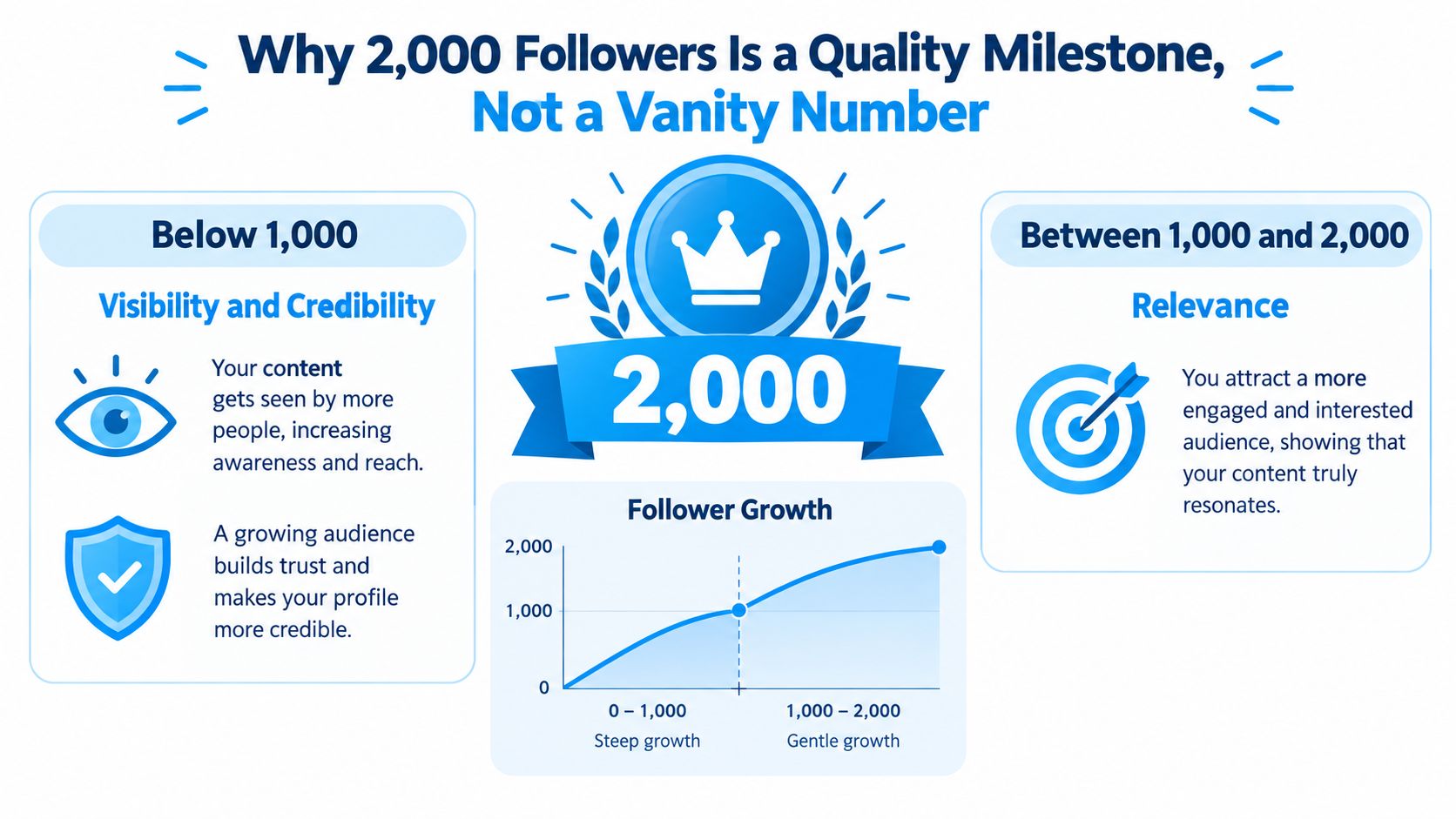
That still doesn't mean raw count should be your obsession. It means the milestone matters because it usually reflects repeat visibility, not one lucky spike. If your account reaches that level with a clear niche, people start seeing your name repeatedly in replies, quote-tweets, and timeline discussions. Repetition builds authority faster than inflated numbers ever will.
What a quality follower actually looks like
A quality follower does at least one of these:
- They're in your niche. They understand the topic you post about and want more of it.
- They can amplify you. They reply, repost, or quote-tweet your ideas into adjacent audiences.
- They can create business value. They might buy, partner, refer, or hire.
- They stay active. They don't follow and disappear. They keep showing up in the comment layer.
Focused followers beat broad followers. A tight group of builders, buyers, or peers is worth more than a large crowd with no reason to care.
Why relevance matters more between 1,000 and 2,000
Below 1,000, the job is mostly proving you're worth noticing. Between 1,000 and 2,000, the job changes. Now you need an account that converts attention into durable audience.
That's why I'd take 2,000 relevant followers over a much larger scattered audience every time. At this stage, every new follower should improve future reach, strengthen conversations around your posts, and make your profile more convincing when someone discovers you through a reply.
If your audience fit is weak, 2,000 followers won't help you much. If your audience fit is strong, 2,000 becomes a usable distribution asset.
Set Up Your Account to Convert Profile Visitors
Most accounts don't have a follower problem. They have a profile conversion problem. People see a reply, click the profile, and leave because the page doesn't make a clear promise.
The fix is simple. Your profile needs one job only: make the follow decision obvious.
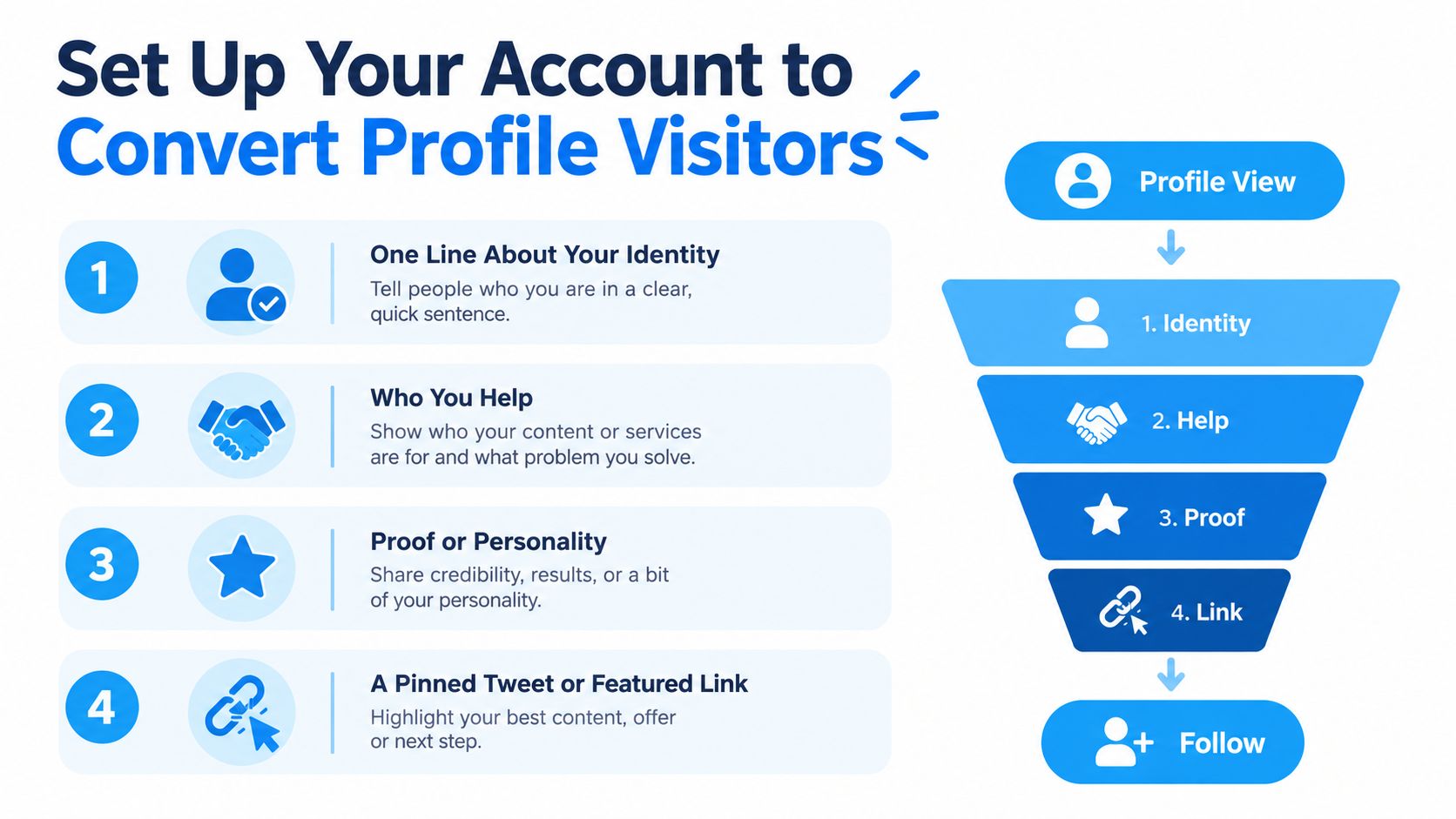
Use a bio that answers three questions fast
Your bio should tell people:
- Who you are
- Who you help
- Why they should believe you
That usually means one line of identity, one line of audience fit, and one line of proof or personality. If your bio still reads like “builder, thinker, coffee,” rewrite it today.
If you want examples that are sharper than the usual fluff, study these Twitter bio examples and breakdowns.
Treat your profile as a landing page
Your profile photo, banner, bio, pinned tweet, and link should work together. Don't make each element say something different.
Use this checklist:
- Profile photo: Use a clear face shot or a brand mark people can recognize in replies.
- Header image: Support your positioning. Show what you talk about, build, or help with.
- Pinned tweet: Pin the post that best explains why following you is useful.
- Link in bio: Send people to the one destination that matches your audience goal.
Practical rule: If someone lands on your profile from a single smart reply, they should understand your niche in seconds.
Audit the small fields people ignore
A sloppy profile leaks followers. Tighten the details
- Display name: Add a niche keyword if it fits naturally.
- Location field: Use it if geography matters for your work, clients, or community.
- Category signals: If your account setup allows professional context, use it consistently.
- Visual consistency: Your banner and pinned post should reinforce the same promise as your bio.
Track profile conversion rate every week. The platforms and benchmark articles around X increasingly push creators to look beyond raw follower counts and audit whether new followers are in the intended niche, active, and tied to a specific post type, as highlighted in Emplifi's benchmark coverage. That's the right mindset. A profile that attracts fewer but better followers will outperform a broad profile every time.
Build Your Content Pillars and Posting Cadence
Stalling before 2000 Twitter followers happens because posts are too random. People talk about ten topics, switch tone every day, and mistake activity for strategy. You don't need more ideas. You need fewer themes and better repetition.
Use three content pillars. That's enough range to stay interesting and enough focus to become recognizable.
Pick three pillars and stick to them
Authority pillar. Teach what you know. Share breakdowns, lessons, frameworks, mistakes, and operating decisions. You prove competence.
Story pillar. Show what you're building, testing, struggling with, or changing. People attach a human identity to the account.
Distribution pillar. Publish posts built to earn replies and quote-tweets. Contrarian observations, tight takes, and discussion starters live here.
Independent research found that informational content can attract followers at a rate 30 times higher than self-focused content, and that excessive hashtag use correlates with lower new-follower acquisition, based on a longitudinal study summarized by Phys.org on Twitter growth research. Build around usefulness first. Save self-reference for context, not the main event.
Weekly Posting Cadence for the 1,000 to 2,000 Band
| Post Type | Weekly Volume | Role in Growth |
|---|---|---|
| Original short posts | 15 | Keeps your ideas in circulation and gives the audience repeated entry points |
| Substantive replies | 30 | Drives discovery from other people's audiences |
| Threads or long-form posts | 5 | Deepens authority and gives you stronger pinned-post candidates |
That cadence works because replies create exposure, while original posts convert exposure into recognition.
If you publish video clips or screen recordings as part of your mix, this guide on Taja AI Twitter upload help is useful for getting the format right without breaking your workflow.
Use repeatable post formats
Don't sit down each day asking what to tweet. Use templates.
- Contrarian takeaway: “Think ___ helps growth. It usually hurts because ___.”
- Numbered breakdown: “Three reasons your X profile isn't converting profile visits into follows.”
- Story hook: “I changed one part of my posting process this week. The biggest surprise wasn't reach. It was who started following.”
Some of your best ideas will come from turning one lesson into all three formats. One post teaches. Another post tells the story behind it. A third invites debate.
For a tighter system, use a dedicated Twitter content strategy workflow instead of improvising every morning.
Run your week on a fixed rhythm
Post your strongest original ideas on weekdays when your niche is active and your own energy is highest. Save one weekend window for a more thoughtful thread or recap. What matters is consistency and pattern recognition.
Retire any pillar that hasn't produced a follow signal in two weeks. If a topic gets impressions but no profile interest, it's entertainment. That might be fine, but don't confuse it with growth content.
Run an On-Thread Engagement System That Compounds
Posting alone won't get you to 2000 Twitter followers on a useful timeline. Replies will. Not random replies. Strategic ones.
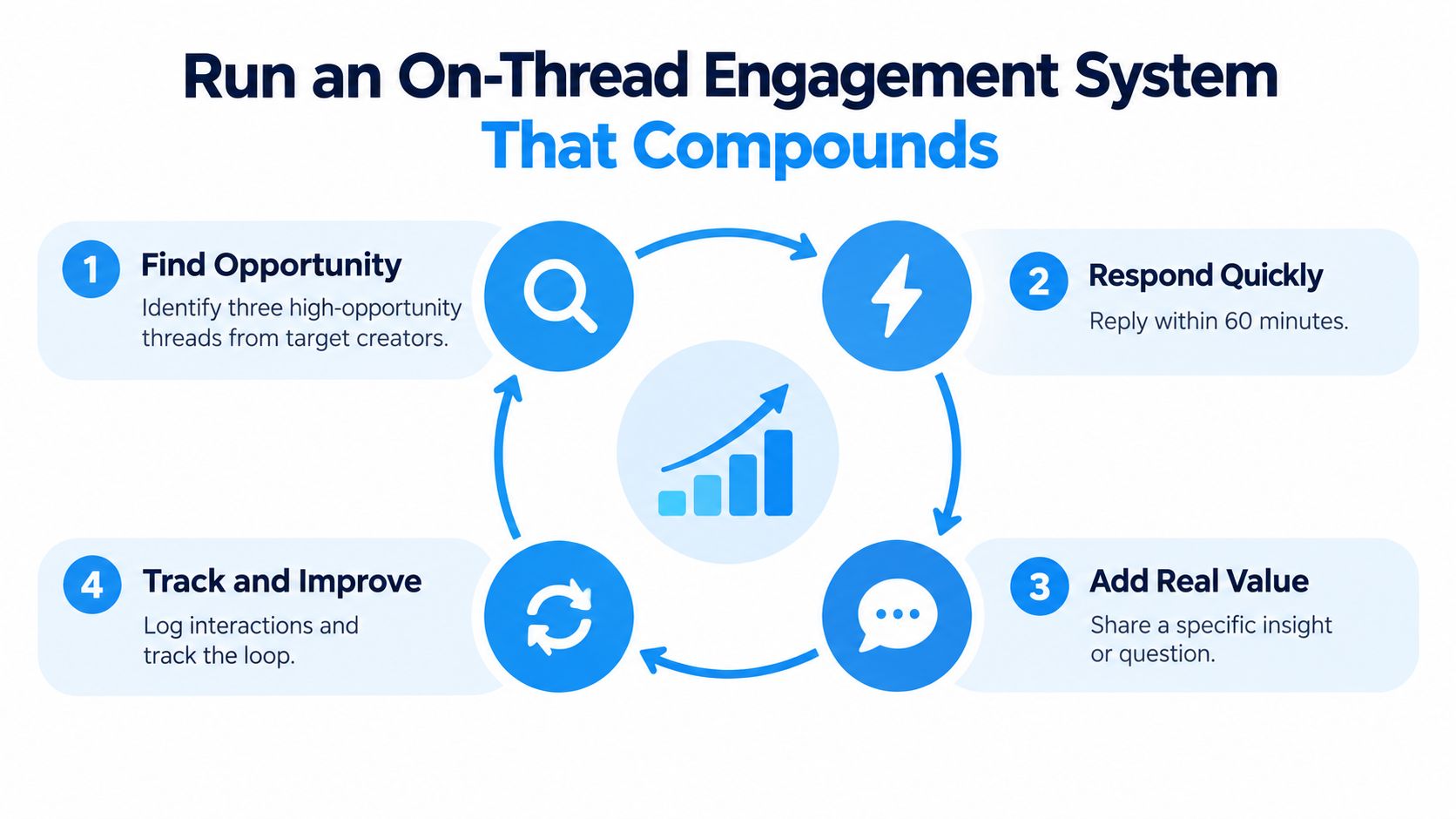
The mistake is treating engagement like spare-time behavior. They comment when they feel like it, usually too late, usually with nothing specific to add. That doesn't compound. A system does.
The daily loop that actually works
Every morning, identify three high-opportunity threads from creators your target audience already follows. Don't wait until the thread is crowded. Get there early and say something that proves you know the topic.
Your reply should include two ingredients:
- A specific observation
- A question or angle that extends the conversation
That combination earns more profile clicks than praise-only replies because people can see you think clearly.
Reply to posts your ideal followers already care about. That's how you borrow relevance without borrowing attention through gimmicks.
A worked example
Say a SaaS founder posts a thread about churn. Bad reply: “Great thread, totally agree.”
Good reply: “We saw churn conversations improve when onboarding content answered the objection before support had to. The surprising part was that the fix wasn't a bigger help center. It was rewriting the first few user moments. Did you notice the same pattern between new users and returning ones?”
That reply does three things. It shows experience. It adds a useful nuance. It gives the original poster an easy reason to answer. Anyone reading the thread now has a reason to click your profile.
Build a creator list and hit it early
Bookmark a focused list of mid-sized accounts in your niche. You don't need celebrity accounts only. You need accounts that post consistently and attract the people you want.
Your operating rhythm:
- Morning creator replies: Hit your first set of targeted conversations early.
- Peer replies through the day: Join relevant discussions with accounts near your size.
- One longer contribution: Leave one more detailed reply or mini-thread where you can show deeper thinking.
If you manage community-style interactions or need a cleaner way to manage brand conversations efficiently, it helps to borrow process ideas from community management rather than treating replies like casual browsing.
Use tools, but don't sound automated
Tools are fine for discovery, scheduling, and monitoring. They're dangerous when they flatten your voice.
One workable setup is to use XBurst for timeline scanning, early-thread discovery, scheduling, and performance tracking while keeping the final wording of replies human and specific. That's the line. Let software reduce search time. Don't let it replace thought.
Your replies should never read like templates. If someone could paste your comment under fifty different threads, it's too generic.
Track the Right Analytics to Stay on Course
If you only watch follower count, you'll make bad decisions. You'll overvalue vanity impressions, underweight profile conversion, and miss the reason growth slows down.
For the 1,000 to 2,000 band, track four numbers every week. Nothing else deserves your attention until these are in place.
The metrics that matter
| Metric | Healthy Range | Warning Sign | Action If Breached |
|---|---|---|---|
| Weekly net followers | Positive and steady | Flat or negative for multiple weeks | Increase reply volume and review which posts drove profile visits |
| Profile conversion rate | Improving week to week | High profile visits with weak follow-through | Rewrite bio, swap pinned post, tighten niche promise |
| Engagement rate per post | Strong enough to show audience fit | Likes with no replies or no conversation | Publish more useful, opinionated posts and cut bland updates |
| Reach per post | Enough distribution to test ideas | Good writing that few people see | Improve timing, hooks, and on-thread engagement |
A practical growth benchmark for accounts in the 1,000 to 10,000 follower range is 5% to 15% monthly relative growth, while a healthy stabilized 28-day growth window is often 0.5% to 3%, based on Tweet Archivist's follower growth tracking guide. Use that as context, not as an excuse. Measure net follower gain by week and normalize it by starting follower count so you can compare weeks accurately.
What the data should tell you
One benchmark source classifies accounts under 5,000 followers as micro and reports average engagement rates of 2% to 5% for that size band, with a separate estimate suggesting only about 4% to 5% of followers may see a given tweet, according to Livecounts benchmark coverage. That's why every follower still matters at this stage. Distribution is measurable, but still fragile.
If your reach is decent but follows are weak, your profile is the problem. If profile visits are weak, your replies and hooks are the problem. If everything is weak, your niche positioning is probably blurry.
Review Sunday night, not whenever you remember. One calm weekly pass beats reactive checking all day.
Keep the review short and brutal
Use a 15-minute review:
- Log net followers for the week
- List your top three posts
- Identify the worst post
- Pick one experiment for next week
If you need help interpreting what X gives you, this guide on reading Twitter analytics correctly is a good reference.
Pitfalls That Stall Growth Between 1,000 and 2,000 Followers
This is the stretch where people get impatient and sabotage themselves. They've done enough work to expect momentum, but not enough disciplined work to earn compounding.
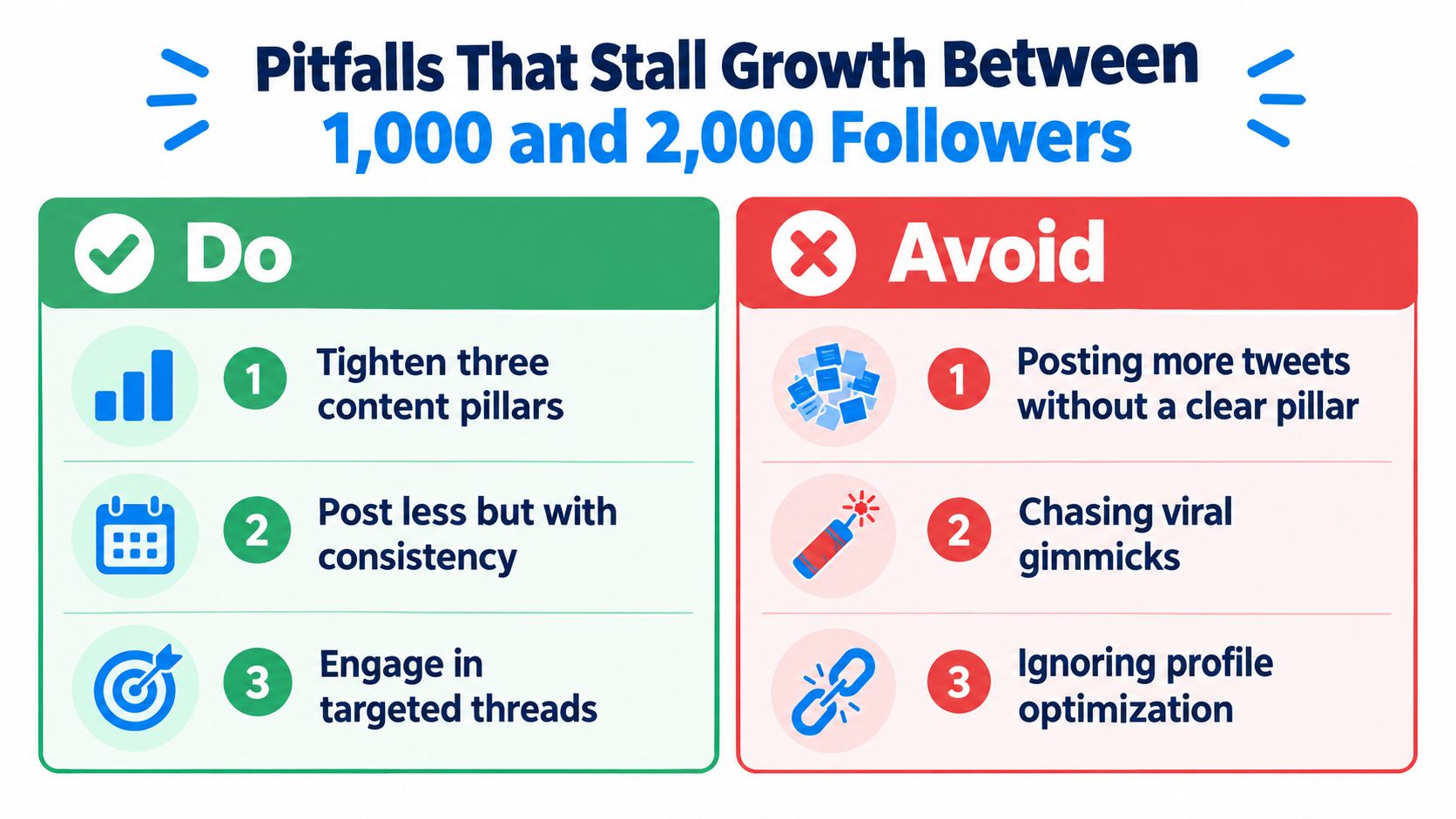
Bad habit versus better move
Posting more without tighter pillars
More posts won't save a confused account. Narrow the message first.Chasing one-off viral takes
Viral spikes feel productive. Recognizable positioning is what keeps people following after the spike.Replying everywhere
Broad engagement looks busy. Strategic thread selection builds actual audience overlap.Buying followers
Fake followers poison your signal. Spend the effort on better pinned content, stronger replies, and cleaner positioning.
Quick self-audit
Ask yourself these five questions:
- Can a stranger explain my niche after ten seconds on my profile?
- Do my last posts clearly fit three repeatable pillars?
- Am I replying where my ideal followers already spend time?
- Did any recent post attract the wrong audience on purpose, just for reach?
- Have I changed tactics too often to let one system work?
If too many answers are no, your account doesn't need a trick. It needs operational discipline.
The accounts that break through this range usually aren't more talented. They're more consistent, more selective, and less distracted.
Your 90-Day Plan to Hit 2,000 Twitter Followers
Don't treat this like a motivation challenge. Treat it like a weekly operating plan. The goal is to improve audience fit, raise conversion, and stack enough useful interactions that follower growth becomes a byproduct.
90-Day Execution Calendar
| Phase | Weeks | Daily Time | Net Follower Target | Primary KPI |
|---|---|---|---|---|
| Setup and positioning | 1-3 | Moderate, focused setup time | Steady positive gain | Profile conversion quality |
| Content rhythm | 4-6 | Daily publishing and reply block | Higher weekly net gain | Reply-driven profile visits |
| Optimization | 7-9 | Daily execution plus weekly review | Maintain momentum by cutting weak formats | Net followers by post type |
| Distribution push | 10-12 | Consistent engagement and repackaging | Strong finish toward 2,000 | Best-performing content reuse |
What to do in each phase
Weeks 1 to 3
Define your ideal follower clearly. Rewrite your bio, update the header, fix the pinned tweet, and publish your first batch of pillar posts. Install a weekly tracking sheet and stop guessing.
Weeks 4 to 6
Raise output. Keep original posting consistent and increase targeted replies every day. Add one solid thread each week. Start each morning with creator-thread engagement before you post your own content.
Weeks 7 to 9
Cut what isn't working. Keep the pillar that drives profile clicks. Drop the one that gets empty impressions. Publish recap posts that summarize lessons and push readers back to your profile.
Weeks 10 to 12
Push distribution harder. Repackage top ideas, cross-post your strongest highlights where appropriate, and clean up dead-weight behavior in your own feed so your niche signal stays sharp.
The win condition isn't hitting an exact number on a random day. It's building an account where the path from impression to profile visit to follow is predictable. Once that machine works, 2,000 is just the first obvious checkpoint.
XBurst gives you a practical workflow for this exact stage of growth. You can use it to spot high-opportunity conversations early, keep your posting cadence consistent, and track follower movement without juggling a messy stack of tools. If you want a cleaner system for building 2000 Twitter followers with better audience quality, visit XBurst.